
by George Banker
The awards stage is the time to celebrate the top performances of all participants in a running event. The tendency is that the first place receives the attention and that person goes in the history books. Stepping back to review an event, the people who followed in the subsequent positions performed to the top of their abilities. Sometimes, there are minutes that separate first and second place.
You can have an event where the runner-up did all the work in the earlier miles only to be overtaken in the last miles of a running event. Time alone does not tell the full story. This article looks back 49 years to the first Marine Corps Reserve Marathon. The race is known as “The People’s Marathon.”
In 1976, the race attracted Olympian Kenny Moore of Eugene, Oregon. Moore placed 14th in the 1968 Olympics despite suffering from blisters. At the 1972 U.S. Olympic Marathon Trials, Kenny Moore and Frank Shorter tied for first place with a time of 2:15:58. In the 1972 Olympics, Moore finished fourth with a time of 2:15:40. Moore ran his personal best in 1970 at 2:11:36.
Standing on the line was West Point Cadet Samuel Maizel, and like most runners, he had thoughts of securing a win. There was no regard for the field as Moore was not recognized at the start. The race had fewer than 2,000 runners.
This article is to recognize who was the runner-up 49 years ago. Below is the letter Maizel shared with the Race Director in 1976.
Over the 26.2 miles, Maizel was consistent, insistent, and persistent in his quest to go for the top place. Maizel will be the first to state he gave his best.
* * * * * * * * * * * * * * * *
MADN-J 16 November 1976 Colonel J.L. Fowler
USMCR HQMC (Code RES)
Washington, D.C. 20380
Dear Colonel Fowler:
On behalf of Major Karl Robinson and the West Point Marathon Team, I would like to congratulate you on an excellent race. Major Robinson and I have run almost a dozen marathons each and we agreed that it was as well organized as any of them. The fact it was your first effort makes your achievement all the more impressive.
There were a few areas which could be improved, however. To begin, the course needs to be more clearly marked, especially since it is a fairly winding one. Both Kenny Moore and I made at least a couple of wrong turns and that can be very annoying, especially near the end of the race. A painted line along the course would solve this problem and can be done fairly easily. Also, after the 15-mile mark, there were no mile markers. In my opinion individual mile markers are not necessary; to be honest they annoy me, but as a minimum marker should show the 5, 10, half-marathon, 15, 20, and 25-mile marks. Times should also be given at those marks. The liquid stops were well placed and frequent enough.
Another suggestion concerns the awards ceremony. Arranging for the awards ceremony to be held quickly after a race is fine, but next year you should try to hold it on time. Waiting around is very uncomfortable after a long race. An alternative idea would be to give all the awards at one time, later in the afternoon. This would allow most people time to shower and change before the ceremony.
A final suggestion concerns the scoring of the race. I believe that the race should be promoted into a military marathon championship. You could establish individual awards for the top ten military runners and increase the military team scoring to three or five teams. Increasing the size of the teams to five men instead of three might also be considered. This is not to imply cutting civilians out of the race but here is a golden opportunity for the large military running community to gain some recognition.
There is one last thought I would like to leave with you. As I was standing on the knoll Sunday in the cool morning air, I sensed true solidarity among all the runners. It is something I have felt at races before but because of the large number of fellow servicemen it was even more intense than usual. Then the Marine Band played the National Anthem, and I saw the crowd rise. With the band playing, the flag waving in the breeze and the monument in the foreground I was truly inspired. It is a scene I shall never forget.
Once again, I want to thank you, and I hope to be able to compete again next year.
Sincerely yours,
Samuel R. Maizel
Cadet, USMA
President, West Point Marathon Club
Below present day Maizel looks back * * * *
What was your why for getting into the sport of running?
I was always a tall, thin, bookish kid. I started running in sixth grade when my parents signed me up to play soccer. The soccer practice was a couple of miles away from my house, so I started running to practice and back. I quickly realized that I was better at running to and from practice than I was in the soccer practice itself. Plus, my dad would play handball at the Paterson, New Jersey, Youth Mental Health Academy (YMHA) one evening per week, and I would go with him and run around a small indoor track while he played handball with his buddies. Finally, I entered myself in some local AAU races, and while I wasn’t great, it was a sport in which I could at least compete.
How did you get into distance running?
I started running seriously in Cross-Country at Wayne Hills High School (New Jersey) in 1969 as a freshman and quickly realized I had some talent. I ran Cross-Country, Indoor Track and Outdoor Track for all four years in high school, got 11 Varsity Letters, was team Captain of all three teams my senior year and was President of the Varsity Club (unusual for a non-football, basketball, or baseball player). I was never All-State in any event but won the New Jersey Schoolboy Marathon Championship with a time of about 2:45 as a high school senior at the Jersey Shore Marathon (now called the New Jersey Marathon) in 1972, and that encouraged me. I finished 27th at the Earth Day Marathon (now called the Long Island Marathon) as a high school senior in the Spring of 1973, which further encouraged me.
Did you run while at the United States Military Academy?
Yes, I ran cross-country, indoor and outdoor track but was never competitive and never got a varsity letter. However, I continued to run marathons with the West Point Marathon Club, although it was a club sport and freshmen could not compete in marathons. I was successful at West Point, finishing 113th at Boston with a time of 2:29:55 in 1975; 3rd at Earth Day with a time of 2:32:50 in 1976; 40th at Boston with a time of 2:33:48 in 1976; 41st at Boston with a time of 2:27:42 in 1977. Of course, my best finish was 2nd place at the Marine Corps Marathon in 1976 with a time of 2:25:02 (my personal best). When I graduated in 1977, I held the Academy record, although it has subsequently been broken.
What was the motivation for joining the military?
As a boy, I read military history, biographies of famous soldiers, etc. A football player two years ahead of me in high school got into West Point, and that made it seem possible to me. My dad (like all his generation) had served in the Army during World War II, although he served as a pharmacist in the South Pacific, and my uncles on both sides had served in the military as well. I interviewed with my local Congressman but didn’t get the initial appointment. However, my Congressman got a second appointment to use on me because the Academy wanted me to run for them.
I loved going to West Point. After I graduated in 1977, I stopped running competitively. I was commissioned into the Infantry, successfully completed Infantry Officer Basic Course, Airborne, Air Assault, Jungle Warfare, and Ranger Schools, among others, and served in the 101st Airborne Division (1978-1980) and the 3rd US Infantry Regiment (The Old Guard) 1980-1982).
The Army sent me to George Washington University School of Law (1982–1985) during which I also interned in the Reagan Administration in the National Security Council (1983–1985). I then served as a Judge Advocate General Officer, serving four years in Germany as a Brigade Trial Counsel for the 3rd Brigade, 3rd Armored Division (1986 -1988) and as the Senior Defense Counsel, US Army Trial Defense Service in Hanau, Germany (1988–1990); and then served as the Senior Defense Counsel for Operation Desert Shield, and Deputy Regional Defense Counsel for Operation Desert Storm, in Saudi Arabia, Kuwait and Iraq (1990–1991), for which I was awarded the Bronze Star Medal. I left active duty as a Major in the fall of 1991.
How was the running environment when you started?
I started seriously running in 1969, and long-distance running / jogging really boomed in the 1970s. A lot of the marathons I ran in were just beginning, and those marathons would have hundreds of people, while today the same races will have tens of thousands of participants. I remember when you had only a few choices of running shoes, and widths were not common. Of course, training was much less sophisticated, as was understanding of the impact of one’s diet.
What was your strategy going into the race?
Given that I had run consistently around 2:30 I honestly thought, given it was a new race and with a military orientation (in the mid-70s the military, still recovering from the Vietnam War, was not held in the high regard in which it is held today) I might have a competitive chance to win. Because it was the first year of the race, there was no way of telling who might show up. My strategy was to go to the front, and stay there as long as I could, from the start.
How did the race play out?
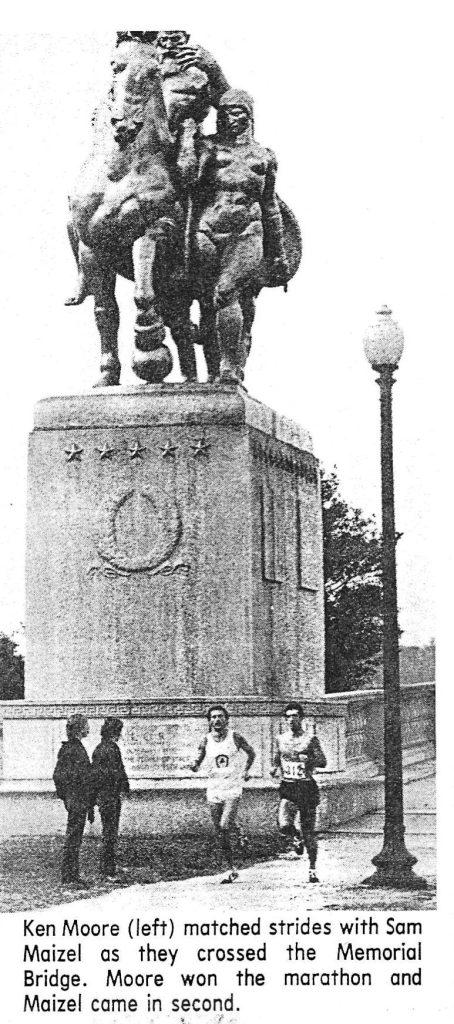
Because we were West Point Cadets and had no budget for this, we had to drive down to Washington DC in the morning before the race in our own cars and then drive the course the afternoon before. In the morning I tried to secure a good spot on the starting line, and when the race started, in accordance with my strategy, I rushed to the front of the pack. Almost right away, another runner pulled up alongside me, and (as the photo in the magazine illustrates) we ran side by-side for what must have been almost 20 miles, leading the race and virtually alone. There wasn’t any conversation as I recall, because we were concentrating (at least I was).
As we approached the last few miles, the other runner simply shifted into a gear I didn’t have and steadily pulled away. Once I realized that I couldn’t stay with him, I started focusing on holding onto second place, which inevitably means that one slows down. There was one runner, not really close at the 20-mile mark, who steadily gained ground on me, but I just had too much of a lead and comfortably finished second. Only after I finished did I learn I had been running with, and finished second to, Kenny Moore, who had finished 4th in the Olympic Marathon four years earlier. The runner behind me was a Marine Corporal (Frederico Builtron), who was the first Marine finisher. All the attention went to Moore (an Olympian, so I get it), and the Marine Corporal (first Marine Corps Marathon, so I get it).
Some funny memories: I didn’t bring socks, so I ended up running the marathon without any socks. When I finished, I realized that the skin on the tops of my toes was all rubbed off. I took off my shoes, and a Marine Corpsman saw me and my feet and offered to “take care of them.” I agreed, and before I could protest, he had poured hydrogen peroxide on my toes to clean them–it hurt like anything. But since I was surrounded by Marines and was myself a soldier in the Army, I had to grin and bear it. I couldn’t look weak to those Marines! We had to then shower and, as soon as the award ceremony was over, jump in our cars to drive back to West Point that night after the marathon, because we were on orders to return by midnight. The next day I had to get a medical profile because I couldn’t put on my regular leather military low-quarter shoes. My company tactical officer refused to let me wear sneakers with my uniform, so the compromise was that I had to wear black slippers to class, meals, etc. with my uniform for a few days, because at least from a distance, they looked like low quarter shoes. The result was a lot of questions from my instructors and classmates, who were always happy when I explained the cause.
West Point Teams
West Point A Team – 4th Place
2nd Samual Maizel – 21 2:25:02
20th James Wolfe-21 2:38:26
44th John Londa-19 2:43:49
West Point B Team – 10th Place
47th William – 29 2:44:26
68th Russell Quirici – 20 2:48:30
84th Ronald Ross – 18 2:51:01
100th Karl Robinson – 34 2:55:19
Comments from Major Karl Robison
We stayed in a motel right along Route 50 east of Fort Myer. The morning of the race, a few of us were eating a modest breakfast in the motel restaurant, which had windows looking out on the parking lot, when you (Sam) went out and started running sprints in the parking lot. There was a table of half a dozen older runners near us, and when they saw you, they started pointing at you and laughing, and I heard one of them comment they would all be seeing you again during the race as they passed you. Needless to say, they didn’t see you unless they stayed for the Awards ceremony! Older is not always wiser.
Comments from Don Kardong, 1976 Olympian (Marathon 4th place, 2:11:16)
As a runner, Kenny was tough as nails. He won several road races and marathons in the 1970s and was one of the first Olympians to embrace road racing, giving the road sport legitimacy. It would have been difficult to stay with Kenny in the last miles of the marathon because he trained specifically to keep the pace during those final gut-wrenching miles.
Statistics
Closest winning times between 1st and 2nd place in 49 years
Ruben Garcia Gomez, 2:22:18, Difference 0:08, 2005, Rank 1st
Carl Rundell, 2:22:26
Kenny Moore, 2:21:14, 1976, Difference 3:38–Rank 40th
Samuel Maizel, 2:25:02
Age Group 20-24
Fastest–Darrell General, 2:19:08, 1987
8th Samual Maizel, 2:25:02,1976
Age Group 30-34
Fastest Hank Pfeifle, 2:17:52, 1981
11th Kenny Moore, 2:21:14, 1976
Overall Winner
Fastest Jeff Scuffins, 2:14:01,1987 (Marathon record)
18th Kenny Moore 2:21:14, 1976
Categories: Athlete Profiles
 Runner's Gazette
Thank you for posting this article about the Marine Corps marathon and Samual Maizel in particular. Brings back memories of racing marathons back in the 1970’s.
I ran the 1979 Penn Relays marathon in Philadelphia in April of that year. The West Point marathon team ran that day & did very well. I’ll have to check my running logs if Maizel raced that day as well.
Thank you.
Ed Bosch
LikeLike