
Interview with Greg Cauller by George Banker
Greg Cauller may not be a household name and many of you may not know him. There are others who know him very well, “That guy came by me, and I couldn’t keep up.” I had the opportunity to place some questions in front of Cauller with the instructions to write what comes to mind. Life is made up of making choices and at times there are no right answers. How do you know if your new training program will give you the desired results? You have to put it to the test.
Cauller steps back to high school to share the journey from then to now. He admits the journey included, “handling both the thrill of success and the disappointment of setbacks.” Along the way he evaluated the setbacks and used them as a learning process to adjust. As the title suggests he had to find the middle ground to share his passion between the runner and the educator. You will not read about what was given up along the journey.
To get to know Cauller, get him talking about his passion. The paragraphs below you will understand what drives Cauller. As you read the following, think about your journey.
From Greg:
I started my running career in the summer before my sophomore year in high school when I entered a contest to log laps around the community pool property, finishing second. I was encouraged by my Big Brother to back that up by going out for cross country, even though I missed summer practices and preseason. The first practice I attended was difficult and humbling, but I persisted, and in my first race I finished ninth on the team in just under 20 minutes for 3 miles. I improved enough over the remainder of the season to make varsity and get under 18 minutes. Most importantly, I was hooked on competitive running, and I was happy in the fellowship of being on a team of athletes who shared my passion for racing and achieving goals. I learned that you could get out of the sport what you are willing to put into it, and the summer before my senior year my teammates and I dedicated ourselves to getting mileage in and preparing for a run at being a highly-competitive team in the upcoming cross-country season. We won the District team title and finished second in the PA state championship. I was district champion and set the course record for 3 miles in 15:18.
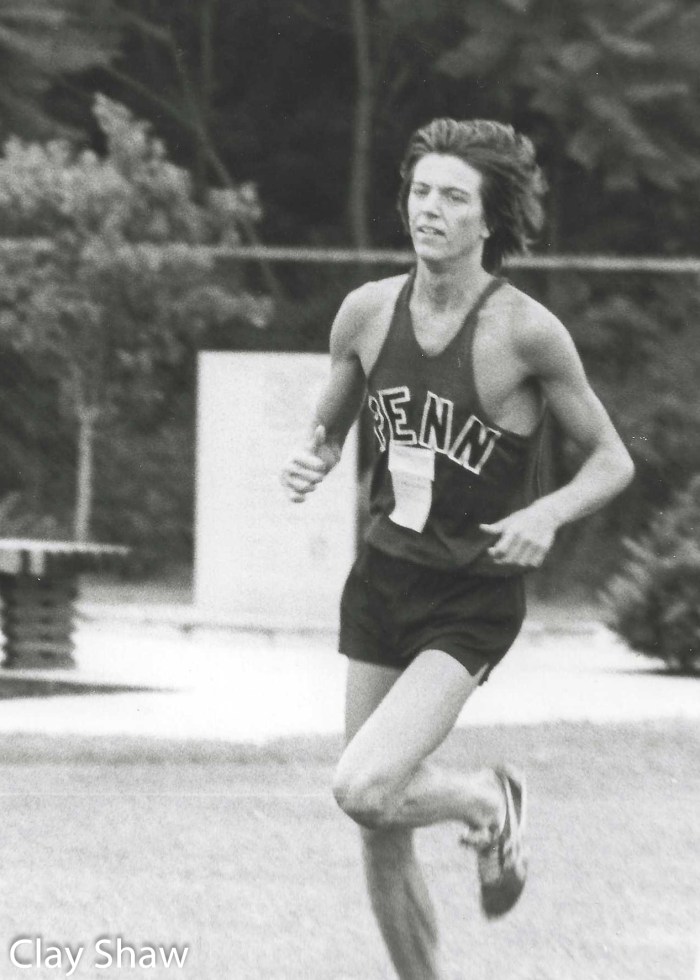
I was recruited by the University of Pennsylvania and won a varsity letter in both cross country and track. Although I was successful as an athlete and as a chemical engineering major, I felt a lack of confidence in the direction my running and studying was taking me, and I took a year off of school to reevaluate my next step. I ended up enrolling at Millersville University (Millersville State College at the time) as a physics major and joining the distance running program. I knew the coaches and many of the athletes on the team, and in my first year we won the PSAC championships in XC and I qualified for the steeplechase at the NCAA D3 national meet, finishing 7th. My senior year emulated my high school experience in that we trained hard going into the XC season, and with the addition of some veteran and freshman runners, we won both the ICAAAA university division team title and the NCAA D2 national team title. I finished as an All-American in XC and in the steeplechase in track. I will always be grateful to Bill Bowers, Jeff Bradley, and Cy Fritz for the invaluable coaching of two very special teams that I have had the privilege to be a part of in high school and college: those two team achievements are still the main highlights of my entire running career.
After graduation, I had the opportunity to go to Yellowstone National Park and work for a summer, immersing myself in the wonder and beauty of that special place. I fell in love with the mountains, including running and hiking on the trails.
I returned from the park and ultimately decided to give it a go as a physics and math teacher at Northeastern High School in York, PA. I came to understand and respect the awesome responsibilities that a high school classroom teacher assumes when accepting that position, and here is where I found a balance between the challenges of becoming the best runner I could be while managing the demands of being an educator of young minds and spirits. I enjoyed the best of both worlds because each of these opportunities required personal commitment, resolution toward achieving goals, handling both the thrill of success and the disappointment of setbacks. Furthermore, I was able to spend professional time with some outstanding teachers and administrators, while my running friends became lifelong and the major platform for my social life.
I am proud to know the Washington/Baltimore group of runners (Berardi, Chattin, Fowler, Mock, Knickman, Adams, Cooley, Banker, et al) as well as the Philadelphia and Lehigh area runners, and the central PA group (Amway, Schuler, Klugh, Shertzer, Bressi, Spence, Demkos, et al). My roommates included Dave Berdan, Justin Krebs, Bill King, and Mike Mykytok. And Clay Shaw and Keith Dowling have been my two best friends over the years, who I never would have met without running and racing.
I was lucky enough to have the talent and the durability to earn sponsorships, primarily with Brooks and Reebok, for almost 30 years of my career as a racer. I represented Races-2-Run for a couple of years in Delaware for which I am grateful to Wayne and Barb Kursh for giving me that opportunity. (As a quick side note…the Kursh’s did an amazing job over decades to create, administer, and promote races in the Wilmington area and beyond, providing certified courses and keeping meticulous records of results and state age group performances.)
I believe that having local caretakers of the sport like the Kursh’s, Clay Shaw and Karen Mitchell, Dave Cooley, Jim Adams, George Banker, Kevin Kelly, Greg Baum, Ron Horn, Bill Smith, and many others, are becoming more of a requirement to support running and racing beyond high school and college. I am hopeful that each of these people and the important services they provide will be delegated to equally-competent and dedicated individuals or teams. My wife and I are currently active in USATF Mid-Atlantic and other groups involved with race promotion and management.
In my open age division years of running, beginning in the early 80’s, there were only a handful of local and regional races (Red Rose, White Rose, York Bon Ton, Capital 5K, Kipona 10K, GW Parkway, Berwick, Reading Hospital, Brian’s Run, Sallie Mae in DC, PDR, Phil Marathon weekend, VA Beach weekend, Cherry Blossom, and more) that were available, so I knew that the best competition in the area would be there. Over time, the race calendar became more saturated, and the fields became sometimes diluted. I always approached race day with these principles in my mindset:
- My race day performance would primarily be a function of my preparation: if my training had gone well then, I should race well, and simply staying calm, focused, and confident during the race was enough.
- I am resolute to accept the result no matter where it fell on the success/failure spectrum. I would celebrate or grieve for no more than 24 hours before moving on to the next race.
- Sportsmanship is fundamental: respect your fellow competitors as being equally passionate about their running and racing; treat them with dignity by winning with humility and losing with grace. Shake their hand with a smile and say “good job” with sincerity. Honor them by giving them your best effort, and win or lose, confirm to them you gave your best effort on that day.
Now that my days of winning races, either overall or as a master, have receded into my past, I am able to gauge the quality of my performances by the Grubb/USATF age-grading tables (which have been recently updated), which give an approximate standard for evaluating the quality of a performance. Certainly my times have slowed down as I have progressed through the age groups, but I can compare my current race times to those of my younger years through the age-grading tables.
As I accept the inevitability of physical decline associated with aging, my perspective on what rewards I can attain through running has also evolved, along with how I approach my training and race preparation. I still feel the passion of racing against runners of similar fitness levels, but now the most basic aspiration I have from week-to-week, race-to-race is to “feel physical and psychological satisfaction” in my runs and races. That is, while I am running, whether it is a race, a workout, or even an easy run, I want to simply feel good. If I’m experiencing aches and pains, excessive fatigue, the desire to be done five minutes into it, then I need to recalibrate in my approach and change my training plan, even modify my lifestyle if necessary.
Fortunately, the evolution of shoe technology and the advancement in the knowledge base for sports medicine have prolonged my career as it has for many of my fellow senior citizens. The quality of the foam used in running shoes has certainly extended my ability to run long distances, and proven medical interventions and treatments have mitigated many of the physiological challenges I have faced. Running on soft surfaces (dirt, grass, gravel, all-weather tracks) constitute the majority of my running routes, weather permitting. I have been integrating more rest days and cross-training into my training cycles, and I don’t pretend to be able to do the same stress load or volume that I was able to maintain as an open and early-year master.
As far as race goals, I am primarily doing USATF local and national races, along with standbys like Berwick and White Rose, in a more limited racing schedule. Perhaps the primary focus in a year’s time is the Boston Marathon, where this year will be my 12th consecutive. The qualifying standard is manageable, so getting the standard and preparing for the racecourse is the motivation for much of my monthly planning. I have not really had a coach in my post-collegiate career (some advisors like Bob Hollis have been patient enough to try), and now my wife Lynn Knothe has been helping me get ready for Patriot’s Day.
Since I moved to Delaware after retiring from teaching in PA and getting married, I have been privileged to join the Tuesday night training group in Wilmington/Newark, facilitated by Jim Fischer, the Hall of Fame high school and college coach who sets up weekly track workouts at a local track (currently St. Marks) and who gives counseling and encouragement to the athletes who attend. He has been doing this as a volunteer for 40+ years, and he has provided such a great service to all of us who aspire to toe the line in a race in this area, that he is universally called “Coach” by everyone. I know many athletes who prefer to have a private coach, oftentimes paid, but I personally am happy to have the guidance provided by Coach Fischer and the fellowship of friends when working out on the track.
I have been blessed with opportunities to coach runners during and after my career as an educator, beginning with running with some elite high school and college athletes at the request of their coaches, to being formally the coach of high school cross country and track teams. I am grateful to all of the women and men who have given their time to coaching in this sport, not only for elevating the interest and knowledge-base for distance running, but also for being transparent and communal in sharing insights and experiences. Staying networked is critical, and I think the recent advancement in US distance running performances in world class levels of competition is largely due to this advancement in the expertise of our coaches and trainers.
I am currently helping at Archmere Academy in Wilmington, assisting the coaches as needed. They believe, as I do, that coaching is more than just writing workouts, but rather the management of individual and group interactions that are the basis for success in a team sport. The fundamental theorem for improvement in running race performance is “you get out of your commitment to the sport what you are willing to give to it.” Furthermore, to be a member of a team or program where there are shared goals, the spiritual rewards attained when each teammate’s hard work helps to achieve a team goal are incomparable and unforgettable.
The selling point to a prospective runner can certainly be to describe the joy associated with reaching individual or team goals in the process, but an argument can be made that the running lifestyle can be linked to lifelong health and wellness as we grow older. At 65 years plus in age, I am receiving excellent health status evaluations in my yearly physical exams and more importantly, I can still do many recreational activities that many people my age no longer have access to. My friend Hugh Campbell, who set world records in distance running in his late 80”s said, “I worked for 35 years and enjoyed 35 more healthy and happy years of retirement as a result staying fit, and I think that everyone should be so lucky”. Even if running isn’t always available as an activity, biking, swimming, hiking, XC skiing, and other pursuits can be a part of post-collegiate adult living. Plus many of these activities give us access to amazing sights and sounds in the outdoors, not only in our own neighborhoods, but in any of millions of places around the world…running in the woods, hiking in the mountains, swimming in the lakes and oceans…so much more fulfilling than seeing photos in a book or magazine.
Some thoughts about improvement in the sport:
- More K-6 youth opportunities available for running, in both urban and suburban areas. Girls on the Run for example, to help promote running as a supplement or alternative to more mainstream sports
- More racing-based running clubs; many running clubs include a racing component but prioritize the social element associated with the fellowship inherent with running. There is room in the tent for everyone, but it seems that there aren’t enough platforms for post-collegiate competitive runners who aren’t professional but still want to train and compete at a high level. We have a club here where we are working hard to get more of these athletes interested in joining.
- Mandating comprehensive education for coaches, trainers, and parents on the general physical and mental health requirements that all children need to stay healthy and well as beginning, emerging, and top-level runners. As someone said, “it takes a village,” and young runners need to have a support team where they can be guaranteed that staging healthy and fit is more important than being fast. Almost every coach and trainer that I know understands and accepts this principle, but parents can oftentimes be more of a challenge to convince.
- I mentioned Wayne and Barb Kursh earlier…since their retirement there have been fewer races in the area and many of them are less competitive. I hope there will be more interest for individuals and groups to consider doing race management so that the quality of local races and the participation numbers may improve. I realize that free entries for elites and monetary awards are less prolific now then when I was younger, but
- I truly believe that the races then were more competitive. Wayne and Barb didn’t give free entries or money for awards, but they did get sponsors to contribute gift certificates instead of trophies or medals for overall and age groups.
- Give back to the sport when you can: volunteer at a race, become a race director, help with youth and school programs…if you feel the sport has been good to you, be willing to do something in return
Some highlights from Greg’s racing career:
Open Personal Bests, Track: 800m 1:55, 1500m 3:55, 3000SC 8:59
Open Personal Bests, Road: 1 Mile 4:05, 5K 14:25, 10K 29:40, 13.1 1:06:50, Marathon 2:25
Masters Personal Bests: 5K 15:18, 8K 25:19, 10K 32:20, 10 Miles 53:08, 13.1 1:12:20, Marathon 3:09
Accomplishments: Hempfield HS, PIAA Medalists XC and Track, Millersville University NCAA All-American 1981 & 1982. ICAAAA XC individual champion.
500 overall wins on roads and trails
16 diamonds from Berwick – Run for the Diamonds
1983 York White Rose 5 Miler- Overall winner
1995 & 1996 Lancaster Red Rose 5 Miler- Overall winner
Notable Masters wins: Rothman 8K twice, Broad Street 10 Miler, York White Rose 5 Miler, Berwick Run for the Diamonds six times.
Greg was inducted into two Halls of Fame: Millersville University in 2002 – and – Pike Creek Valley Running Club in 2018
The link below is from an earlier Northeastern Community interview with Greg Cauller. Below the video, find photos.




Categories: Athlete Profiles
 Runner's Gazette
This is a wonderful article about a longtime gem in the Central PA running community and beyond. His credentials as a runner speak for themselves, and they are stellar. But even more important to all of us is how much he supported, promoted, and cared for the local running scene.
Over the years Greg participated in many of the local races. Many were for a good cause, some just fun local events. Greg’s presence gave creditability to these small races. He was there to support and to promote local running, often forgoing the opportunity to run a “money race” that could have benefitted himself. His loyalty did not go unnoticed.
His availability to and his encouragement of local runners of all ages and abilities is another commendable trait. Greg was an elite runner, yet he remained approachable to everyone. He was one of us, and he never passed on the opportunity to converse with, offer advice and encouragement to aspiring “middle of the pack” runners who were in awe of him. One has to believe that he inspired some of us to our own higher levels of running success.
Great athletes don’t always make good coaches. Sometimes they expect more than mere mortals can give. But Greg was the exception. He was a good coach. Everything he did as a coach was done with the intent of helping his runners. No, that is not true! He did things to help all runners, even his competition. Whether it was making certain that the proper equipment was available, providing for responsible training programs and developmental programs beyond the school teams, even prodding the scholastic running community to make changes that could possibly benefit the athletes, Greg was always pushing that direction.
Greg is worthy of all of the accolades that he receives. I have watched him interact in all phases of the running world. He is a good and caring guy. That is even more important than his running successes.
Greg Baum
LikeLike
This is an awesome article. Greg’s impact & contributions to the South Central PA running region and beyond are far reaching & he’s impacted many generations of students(student-athletes) via his knowledge, guidance and tutelage. His teams were always competitive. I can confidently say the running scene both locally & regionally would look entirely different if it wasn’t for Greg, Clay, Hollis, Baum,Amway,Bradley,Blood,and countless others I want to name, but need to keep this comment concise. Congratulations to Greg on all his accolades. Best wishes in Boston!! Even though a Millersville guy and myself a Shippensburg guy (I had to get that little tease in..,ha) I have tons of RESPECT for all Greg has accomplished and what he will still attain. Best Regards my friend!
LikeLike
This is a really nice article – thank you George Banker and Greg Cauller. Especially Greg for the insights you shared about running through the years, preparation, sportsmanship, and running as we get older. His excellent writing here indicates that Mr. Cauller could have been an English teacher as well as a math and physics teacher. He has inspired many people, in the class and on the roads and trails.
LikeLike