
By George Banker
It was a privilege to interview Creigh Kelley and I thank him for his time. I also asked several leaders in the running community to give me their thoughts about Creigh. Their answers give you an introduction to this man.
Kathrine Switzer: “Creigh Kelley has been the face and the voice of so many races for the past 40 years of my life. It is as if we grew up together! Whether he is MC-ing the expo or the finish line, or a panel discussion from Boulder to Baltimore, Creigh never cannot bring out the best in the event, the race, and the individual. My favorite moments are crossing a finish line in a place like Las Vegas and being interviewed by Creigh or watching him stand at patriotic attention at the start of a major race in New Orleans or lift the tone of and pump the enthusiasm in a panel discussion in Colorado.
Upbeat is the single most descriptive word for Creigh, but when he is accompanied by his lovely wife Renee, there are sunbeams, too. Remind me to tell you about the time we did a television stand up together before the start of a race in West Virginia before we jumped on the lead camera truck. And the truck left without us, standing in the road holding our microphones.”
Ted Metellus: “Creigh Kelley has always been an engaged and vocal leader in the industry. Creigh’s warm smile, distinguished voice, and love of running have made him known in the industry. Wishing Creigh the best and happy that he will continue to contribute to our industry and sport.”
Jeff Darman: “Creigh has had a remarkable influence on our sport. He has experience as a business owner, race director, announcer, volunteer leader at USATF Men’s Long-Distance Committee, philanthropist and as an excellent runner to top it off. He has had a unique career and has mentored many along the way. His engaging personality makes him light up a room when he enters.”
Keith Peters: “Is there any job in the running world that Creigh Kelley hasn’t had? Race organizer, athlete agent, national-class runner, event announcer, philanthropist — you name it, Creigh has done it with a smile on his face and goodwill in his heart. For well over 40 years, Creigh has been the consummate running professional.”
Here are my questions and Creigh’s answers (with some editing)
WHY did you get into the sport?
In 1962, as a sophomore at Staples HS, Westport, CT, my life changed dramatically when a good friend, Kevin Cunningham, told me there were track tryouts happening and we should go to the track.
This “God Wink” placed me on a new pathway, very different from the one I was once on (that of being a budding juvenile delinquent).
I made the team, became a tri-captain of the XC team in 1963 and began a life journey, living in and embracing the sport of long-distance running.
What was your progress in the sport? (Here Creigh gives insight into his family, sport and most interesting life.)
Eventually placing 5th in the CT state meet in the two miles, I landed at the Virginia Military Institute (VMI) in the fall of 1964. It was a shocking change in culture, but I found new teammates and another level of competition that would sustain me over the next four years.
After college, I was commissioned in the US Army as a 2nd LT in the Artillery. Since running wasn’t a priority in my life, I gave it up and started smoking up to a pack a day.
By December 1969, I headed to Vietnam for my year’s tour. Being in great shape, despite smoking, I adjusted to being in an airmobile 155 howitzer battery for the first five+ months. After that, I volunteered to be the artillery LNO and FO for a Regional Popular Force South Vietnamese infantry company. Finishing the tour with no wounds, I transferred to a nuclear Honest John Rocket Battalion, 1st Infantry (Fwd) in West Germany from 1971 to 1973.
The only running I did as a Captain was leading my firing battery on 2-mile runs.
Separating from the Army in August 1973, I completed my masters in International Relations at the University of Southern California and settled in Atlanta, GA. Awards in the military included two Bronze Stars, the Vietnamese Honor Medal First Class and the Army Commendation Medal.
In the Spring of 1975, we learned that my wife, at the time, was pregnant with our first child (Becca). I also simultaneously learned in an article in the New England Journal of Medicine that smoking around a pregnant woman could be harmful. This “God Wink” guided me to stop smoking immediately.
Within one week, a friend recommended I go to Phidippides, a new running store (one of the very first ones in the US), and get a pair of running shoes. There I met Jeff Galloway, 1972 Olympian, who sold me a pair of Nike Road Runners. Jeff volunteered to be my coach, and my life was changing dramatically again. By 1978, I was moving our family to Colorado to open a running store in Denver in August 1978. Meeting Jeff and having him be my first, actual distance coach was yet another “God Wink.”
My son Meade was born in 1979 in Aurora, CO, where we built our home.
By 1980, two new friends and I formed a for-profit company, BKB Limited, to put on running events and represent world class distance runners. This would become the way forward for me and would lead to my new career in national leadership with The Athletics Congress (now USA Track & Field). By 1982 I was Co-Chair of USA Long Distance Running with World Champion Craig Virgin and by 1984 I was the National Chair of USA Long Distance Running.
During this period, I began my over four-decade career in event announcing, TV and radio for distance running events, track and triathlon events.
By 1985, I had sold off my Phidippides store, my daughter Page was born in Denver, CO, BKB Limited had full-time offices in Denver, and my wife filed for divorce. Life was a mixture of turbulence and excitement.
My personal running was decent in terms of age group competition. The Olympic Trials were out of reach, and I concentrated on representing athletes, putting on races and announcing. Those three things became my career stepping stones in the 80s decade.
In 1984, as one example, the Mexican government asked me and I accepted the responsibility to put on a race in Ixtapa Zihuantanejo, Mexico. It was an ambitious project. Many of my athletes ran in the race including Jon Sinclair (over one decade was ranked by Runner’s World as the best road racer in the world), Anne Audain (New Zealand Olympian), Charlie Spedding (Great Britain Olympian) and David Edge (Canadian Olympian). I announced, along with a Spanish-speaking announcer, and it was a tremendous success. We received a commission to organize another race in Cancun and then return to Ixtapa in 1985, but the disastrous Mexico City earthquake in the fall of 1985 permanently cancelled those events.
The selection committee chose me to be the USA Team Manager for the World Cup Marathon Team in Seoul, South Korea, in 1987. By this time, my personal running had led me to a 2:32 marathon (1982), a 32:48 10K (1983), and a 15:30 5K (1983). As a newly minted master’s athlete, I ran the Honolulu Marathon in 1987 in very adverse conditions (75 degrees, heavy rain for the first 13 miles and high humidity) in 2:44, placing 31st overall and 5th masters. To this day I consider that my best performance.
Through good fortune and leading into the 1990s, I became the TV commentator for the Bloomsday Road Race, the US National Half Marathon Championships with Kathrine Switzer (Parkersburg, WV), the Elby’s Distance Classic 20K (Wheeling, WV), the Red Lobster 10K (Orlando) thanks to Jon Hughes and the Columbus, OH Marathon. I continued to announce the Cherry Blossom 10M (to date, over 25 times) and continued to be the radio color commentator for the Chicago Marathon, to name a few. In 1992, I was the co-commentator for the World Cross Country Championships in Boston with Toni Reavis.
By 1995, my company BKB Limited was managing over 40 races each year, my announcing assignments took me to over 25 communities in the US and I added a couple of announcing assignments at the Olympic Marathon Trials. Beginning in 1995, thanks to Jon Hughes, I began a 30-year career announcing and emceeing at the Walt Disney World Marathon. For several years, I was the color commentator for the TV broadcasts of the Big 8 and Big 10 Track and Field meets. In 1996, I was the lead announcer for the ITU World Triathlon Championships in Cleveland, OH. By the end of the decade I had also been the Team Coach or Team Manager for USA National World Relay Championship teams in Denmark and Greece and at the Chiba, Japan Relay Championships.
One of my favorite assignments was becoming the lead announcer for the Danskin Women’s Triathlon Series in the mid-90s that continued into the next decade. When the series wrapped up, I had been their voice for over 100 events.
An Italian company chose BKB Limited, Winning Time, to debut their chip-timing services in the United States and in Mexico. We were the first company to chip-time the Athens Marathon successfully, the first race in Greece, and the first chip-timed race on the island of Cozumel, Mexico. We were one of the pioneers in chip-timing races in that country.
With the partnership of two friends who served on the Board of Leukemia and Lymphoma Society (Rocky Mountain Region) we launched the Cozumel Marathon, a fundraiser for LLS and included a triathlon by 2001. We raised over 3 million dollars during the three years. 9/11 cut those events short and then by some devastating hurricanes.
By 2000, I became a Board Member (thanks to Nancy Hobbs) of the International Sport at Altitude, became a founding member and Board Member of Running USA, a Coach of Team in Training and Board Member of the Leukemia and Lymphoma Society (Rocky Mountain Region) and on the Executive Committee of USATF’s Long Distance Running Division. ABC Sports Radio selected me to be the Sydney, Australia Olympic color commentator for Track and Field, Marathon and Triathlon. For me, this was a personal highlight. I recall that when they originally asked me if I knew anyone who could fill that role, if I had suggested someone else and not blurted that “I can do it!” life would have been different. This was another “God Wink.”
During the decade of 2000–2010, we had new opportunities that included assisting Steve Marks in launching the Akron Marathon in 2003 and then, in 2004, collaborating with Jean Townsend to debut the Denver Colfax Marathon in 2006. In 2007, I ran my last marathon in Enschede, Netherlands, at 61. I was on pace to hit 3 hours, but the wheels came off with less than 3 miles remaining. I hobbled in at 3:23, but ironically received 100 euros for placing in my age group. It was the only prize money I ever earned.
During my first visit to Kapsabet, Kenya in 2003 with Peter Tanui (my now longtime close friend who was at that time a graduate of Lubbock Christian University and roughly 18X NAIA All American) we toured the very rural Kipture Primary School where he had become the first of their graduates to graduate from an American university. As we walked around, I casually mentioned they needed a proper library and a kitchen and the Headmaster promptly announced that I would do that. This was another “God Wink.”
In 2004, we formed the 501-c-3 non-profit Kipture Primary School Foundation and have successfully raised funds, thanks to the generosity of a legion of friends, to build a library, kitchen, several classrooms and a solar-powered well that not only serves the school but the nearby rural medical clinic. Fundraising is ongoing and all funds go directly to projects. There are literally no administrative or other overhead expenses. Today Peter and his family live in Colorado, where they have all become US citizens and lead successful professional lives.
In 2006, I divorced my second wife and met Renee Hamilton who became my best friend and life partner.
From 2011 to 2020, my life veered hard into a crisis when I learned in 2012 that I had cancer. Amazing medical staff operated in early October and removed a kidney and I began many rounds of chemo. I tried to continue to announce after chemo began, but the last event in 2012 I planned to announce was for Dawna Stone in St Petersburg, FL. I actually arrived at the start line in rough shape, but Dawna immediately sent me to a nearby hospital and flew me home. My principal caretaker became Renee Hamilton (who became my wife in 2024) who coordinated my three children’s visits (Becca, Meade and Page) and kept my spirits up.
By the end of February 2013, I was cancer-free and ready to tackle running again after a six-month hiatus. The only lasting effect was my running pace had suffered, and I had to be content with never being able to break 20 minutes in a 5K again.
My announcing was still in full swing during the decade, including the Peachtree Road Race. That was one of my favorites because I had run the race in 1978 in under 33 minutes.
During this decade Lonnie Somers (my good friend and now the newly minted Race Director of the Denver Colfax Marathon Weekend), who is the owner of Hal Sports event management and timing company, and I cemented our co-ownership of the RunDenver 5 Race Series. It’s a series I had established in the 90s. Lonnie invested time and energy into the series that was drifting along with a few hundred participants in each event and developed it into a series with over 1000 participants in each event.
The Spring of 2020 saw the world being flipped over because of COVID-19, forcing Andrea Dowdy, CEO of the Colfax Marathon Partnership, Inc, and me to cancel our May event and shift our work to creating “Guidelines for Outdoor Running and Walking Events.” By July, the Colorado Department of Public Health and Environment accepted those guidelines and became an open-source document that was eventually used throughout the US and in some countries overseas. The National Center for Sport Safety and Security (NCS4) celebrated our “Guidelines” accomplishment by honoring Andrea Dowdy and me with a national award in 2022.
By 2021, we could relaunch our “makeup” Denver Colfax Marathon Weekend in October and then got back on schedule in 2022 in May.
In the fall of 2022, I mentioned to Andrea (who today is one of the most impressive leaders in our sport) that I intended to step away from being Race Director in May 2024. By 2024, the Denver Colfax Marathon had a participant level of almost 25,000. In the future, I agreed to co-announce the event in 2025.
For me, this was a perfect capstone on my being Race Director.
In December 2023, I wrote to the leadership at the Walt Disney World Marathon that January 2024 would be the 30th and final year for me to be part of the Sports Host announcing team. As with so many things in life, you should be alert to moments of change, and this was one of them with no regrets.
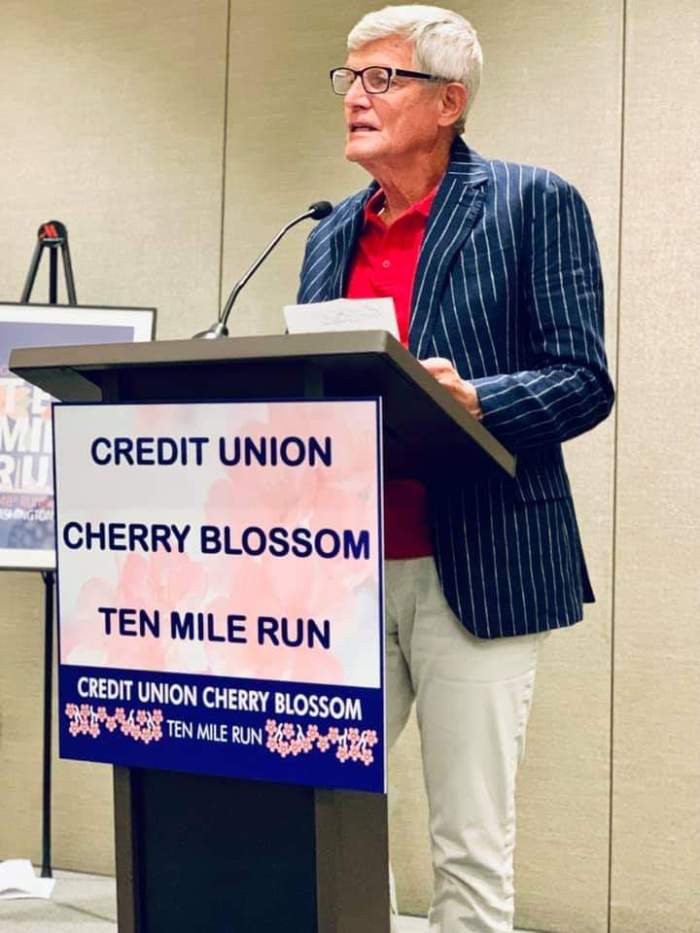
In the future, my announcing career will still include the Fort2Base races near Chicago for Beth Salinger in August 2024 and the Madtown races in Madison, WI in late May. Joe Moreno has asked me to continue at the Quad Cities Marathon in Moline in September. Phil Stewart continues to have me return to the Credit Union Cherry Blossom 10M and Steve Lastoe’s Brooklyn Half Marathon in April is a fun weekend. Locally in Colorado, I will be at the start line of the Denver Bronco’s 7K and the Mile High United Way Turkey Trot 4M.
During these four decades plus, my awards have included The Athletics Congress President’s Award, USATF National H. Ross Browning Long Distance Running Merit Award, the Illinois Silver Dome Excellence in Broadcasting Award (Chicago Marathon), induction into the Running USA Hall of Champions and the Colorado Running Hall of Fame, and the Marathon Foto/ Road Race Management Lifetime Achievement Award.
What distance did you run in college?
XC was usually 5 miles, and I was typically in the top 10 in the State of Virginia XC Championships. Indoor Track was usually the 2 miles and mile. The coaches always had me doubling since I could pick up points in every meet. Outdoors was the 3 mile (5000m wasn’t in place in the Southern Conference yet), mile or the steeplechase. Again, I would do a double.
Although my times were adequate, they weren’t earthshaking. I was only running 30+ miles/ week, and the coaching was very average. My successes came on the leadership side. After my freshman year of track, my 100+ teammates honored me by selecting me as the “Team Captain.” By our senior year, my teammates selected me as Co-Captain of both the XC Team and the Track Team.
If you have to select three topics in the sport which need to be improved?
- The elevation of our elite athletes in the eyes of the public will tip the scales positively for all events. In order to accomplish this, the national governing body, USATF, must shine a much brighter light on the distance runners. USATF, spends wasted dollars on staff and administration instead of underwriting the careers of the distance stars.
- With full appreciation of the commitment of runners to get to the starting line, it is a physical fitness error to keep extending the time limits for marathons and even half marathons. Instead of adopting a “come one, come all” philosophy, there should be greater emphasis on health training to ensure that runners can achieve basic time goals. Too often, event managers bend to the will of a relative handful of participants who cannot or will not train appropriately for distance events. With full recognition of others who are not physically equipped to cover these longer race distances in the time allotted, there needs to be a wider education effort to reach those who argue for relaxed standards to know the “why” these time limits exist (municipality rules, volunteer limitations and other economic constraints that negatively impact the fiscal management of an event).
- Continued upgrading of safety and medical practices should be a priority for all events. Staying abreast of best practices and attending national/regional conferences (Road Race Management Race Director’s Meeting, Running USA Industry Conference and the NCS4 Marathon Summit are three nationally important opportunities, plus Mike Nishi’s gathering in Chicago every June) provide the latest information for staging a better and safer event. Our wonderful sport has the most open and transparent operational and informational knowledge base of any industry. Event managers and directors should avail themselves of every available resource.
When it comes to competition among athletes, should there be a limit to technology assistance?
This query highlights the trend with running and racing shoes. As long as the national and international governing bodies agree to the changes (it is in their respective charters to manage these changes for the betterment of the athletes they serve), then it is fair and, more importantly, equitable.
In a fascinating emerging development, a sensor-packed running track is being developed by Feldspar in Great Britain that will be available in 2025. If it were available to everyone (I doubt the business model is immediately achievable) running watches would go the way of a stopwatch.
In relation to the question above, there have been shoe technology advancements and clothing, but everyone can’t afford them. Would this be an injustice?
As noted, it must be equitable. As shoes drift upward in price too well over $200, the price makes it more and more exclusionary. Past years and decades have shown that an athlete striving for excellence can achieve significant performances with basic running shoes and basic shorts and tops. Once they get to a certain level of performance, smart coaches and sponsors will take note. Those emerging stars will get whatever they need to go to the next level.
Although the question does not directly mention the use of Performance-Enhancing Drugs (PED’s), I believe this continues to be the greatest threat to our elite athlete development and acclaim. Until the international and national regulatory agencies along with World Athletics manage this potential crisis, the public will continue to raise eyebrows about the legitimacy of performances.
From your perspective, what have been some changes you have noticed over the years?
There are three significant changes that have taken place during my time in the sport since 1978.
- The acceptance of women into the long-distance running events. That growth found its public genesis with Roberta “Bobbi” Gibb in the 1966 Boston Marathon and the now infamous Jock Semple’s attempt to stop Kathrine Switzer at the 1967 Boston Marathon. Over the next decade plus, Kathrine Switzer was the face of the movement with events like the 1978 Avon Women’s Marathon that you could trace directly to the 1984 Women’s Olympic Marathon that was won by Joan Benoit Samuelson.
Every running event directly benefitted from including women. Decades later, most events have a higher percentage of women than men. That translates into huge cash inflows for non-profit and for-profit events and provides incredible role models for young women in families around the world, enhancing the total population’s health and fitness. - The acceptance of walkers into the ranks of traditional running events. This started in the mid-80’s as time limits of events gradually lengthened. It seems ironic now that in the late 80s the Boston Marathon refused to give finisher medals to runners who did not break four hours. Today, every participant in most races receives a “finisher” medallion or token.
Recalling the consternation of event managers in the 80s about extending time limits to six hours for a marathon and to consider providing a medal to every finisher, it is ironic how much those decisions contributed to the financial success of events in the present day. - The emergence of charity runners. Small charity events were the norm in the 1980s. Organizers launched 5K races that would emphasize a charitable cause as the main purpose. Primarily because of the fundraising model named Team In Training (TNT) begun in the late 1980s of the Leukemia Society (now LLS, the Leukemia and Lymphoma Society), runners carried the flag for charities, ran in races wearing their t-shirt or running singlet and spread the word about those races they were running in behalf of the charity.
Other charities adopted similar models. By the end of the 1990s, literally hundreds of charities had programs designed to raise money and organize marathons. Event managers were quick to jump on this bandwagon and make room for charity runners. It accomplished several things, some of which present uncomfortable dilemmas for event directors today.
First and logically, charity participants meant more entry fee revenue. Second, those charities and their runners spread the word about the event they would take part in. This was essentially free advertising and had a corresponding cumulative effect. Third, it introduced non-runners to a theretofore unavailable or unappealing activity. Most would eventually adopt the activity as part of their lifestyle.
The downside was that many of the charities, unlike LLS, did not have a true training program with coaching that they monitored and, more importantly, provided. This brought untrained and unfit people to the start line who might present a medical emergency to the event or at the very least be unable to complete the event in the mandated time.
No one, least of all the event managers, wants unhappy participants, especially in today’s social media frenzy. This goes down as “no good deed goes unpunished.”
How did the Colfax Marathon progress to the event it is today?
Every event has a timeline that dictates growth and value. Jean Townsend and I, the two co-managers in 2004 selected by the municipal leadership, made three very important decisions prior to launch in 2006.
- Pick a date that would be weatherproof as possible. We researched the prior ten years of weather data from the month of March to the month of November. It became apparent that the third Sunday in May (that floats a bit every few years) was the overriding best date.
- To ensure we would survive municipal leadership changes, we opted to become a non-profit 501-c-3, the Colfax Marathon Partnership, Inc. This became critically important over the next ten years when other for-profit events became disenfranchised by municipal leaders.
- We recognized that running a marathon at a mile high would not be the first choice of a runner. Going back to the very popular model of the marathon relay I had become familiar with in the 1990s in Denmark, Greece and Japan, we adopted the marathon relay to go hand in glove with the marathon. Eighteen years later, it comprises 20% of our total participant level and is the largest marathon relay in America.
After the smoothing out of selecting the best CEO for the Colfax Marathon Partnership, Inc. (we had stops and starts for the first four years) the Board selected Andrea Dowdy to take the helm in 2010. Andrea, using her deep business management background, retooled the entire event after 2010, and by 2011 the event grew significantly.
Jean Townsend had taken on the Charity Partner Program as its Director in 2008 and with the new leadership of Andrea Dowdy in 2010, the program grew quickly. This program has flourished and today our charity runners have thousands who run in the name of their charity across the five available events over two days (5K, Urban 10M, half marathon, marathon and marathon relay). The program is unique in the world and has over 125 charity partners each year. The charities do not pay to be a part of the program, and hundreds of thousands of dollars flow directly into those charities every year.
What are the elements of a successful event?
Sometimes circumstance and a bit of serendipity are catalytic converters. However, there are core elements that make an event successful. These are some of them.
- Practice fiscal responsibility. Create a budget that reflects the essential cash flow that predicts a conservative but positive outcome.
Set aside monies each year to provide for a “rainy day.” 9/11 and more recently COVID-19 shown a bright light on preserving funds. - Select the best talented people to staff your vital management roles. As your event grows, reward your experienced managers. The longer you can keep solid leaders, the better your event will become. Sometimes the rewards are in bonuses or raises, but other strategic rewards are always on the table.
- Develop and constantly review and update your operational, promotional and sponsorship plans over the next three to five years. Anticipate growth and analyze how that growth will affect every element of your event. Surprise is not your friend.
- Plan for learning opportunities. Ask for help from your peers and attend meetings and conferences to compare notes and to learn new information. Never believe you have “cracked the code.” The moment you sit back and relax, you’re likely going backwards. By the time you discover this error, you maybe are too late.
- Although “lean and mean” can save money in the formative years, do not neglect including budget line items that have a face-forward impact.
- Include a “safety of participant first” plan.
- Have a robust medical and on-course emergency medical plan.
- Hire a proven timing company.
- Have a formal Water Station plan with a paid Water Station Director.
- Keep a seasoned PR person to carry your message.
- Pay attention to including professional safety personnel to ensure your course is managed in the most robust fashion. You must hold your course managers to the highest standard. Make them a priority in your budgeting.
- Nurture extra and developing excellent municipal relationships. In a crisis, those municipal managers and staff personnel can quickly become part of your solution or become your greatest threat.
- Make sure the participant benefits (shirt, medal, post-event refreshments) are of the highest quality within budget constraints. Feeding and clothing of your participants will always pay dividends.
- Make volunteer sourcing and management a priority. Consider paying stipends/donations to volunteer groups to ensure they show up with the requisite numbers.
- Did I mention having qualified emcees and announcers? 😊
What are skills required to be a successful director?
Leadership is not an automatic quality. It must be “learned and earned.” A race director, like any excellent manager in other occupations, should volunteer or place themselves in the roles of the managers they will supervise.
Know what it’s like to recruit volunteers, build and service a water station, manage a course (including course marking, brief course marshals and directing the flow of participants), be able to answer participants questions in writing and verbally, be completely familiar with the budget and its execution, understand how to become a resource and valued contributor to your CEO/ Executive Director (and be prepared to follow that person’s lead), and never underestimate the importance of engaging your management team leaders to make sure they feel valued.
The successful race directors whom I’ve known over the years are “leaders by example” and have grown through taking on basic roles. Traveling to other events and “looking under the tent flap” is incredibly helpful.
Empathy and calm decision making in the line of fire are essential.
What is the value of having elite competitors at an event?
Depending on the mission of the event, they are the valued “tip of the spear.” Elites can be valuable advance spokespeople for the event and can contribute in a variety of ways to the public opinion and public view.
If an event can capitalize on the elite athlete’s background, bring them in to attend a charity event that will add to publicity, or be an additional PR talking point. Again, it depends on the stated mission and purpose of the event.
Does having prize money enhance an event?
If the event’s main talking points include the elite competition (consider the BOLDER Boulder’s competitive elite teams, Memorial Day themed activities and thousands of runners finishing in a college stadium or the Credit Union Cherry Blossom 10M, with a National Championship event, a major charity activation along with the spectacle of celebrating the blooming Cherry Blossom trees) then the big prize purse is of major importance. A minor prize purse can still add to the “tip of the spear” without breaking the bank. Course and State record bonuses always interest emerging elite athletes.
Thousands of purely charity driven events have been quite successful without an elite component, so it’s not true for every event that elite athletes always improve the event.
What advice can you give to managers of elite athletes who have received invitations to events? Should they be available for interviews and attend award ceremonies, etc?
Agreements with elite athletes (particularly if the event is providing free entry, transportation, room and board) should be in writing. Athletes should be required to attend scheduled advance press conferences and, following the event, they should attend press gatherings and awards ceremonies. It all needs to be clearly stipulated, so there is clarity. Athletes that show up at the last minute (day prior or event morning) should be excluded from the elite or advance start and should not be offered a complimentary entry unless it’s part of their agreement.
Some events have a higher percentage of female finishers than males. What are your thoughts to explain? This has not always been the case.
As I mentioned earlier, running events have welcomed women for over four decades. It is not surprising that they dominate the percentage of finishers. The participation levels should thrill event directors.
You facilitated a diversity panel for Running USA several years ago. Do you feel it was beneficial?
This is an interesting topic. No other sport has such an “open arms” philosophy. Events are continuing to figure out how to be more inclusive. In an ideal situation, the percentage of people in an event should proportionately reflect the overall percentage they represent in the US. As an example, 12% of America identifies as Black but only 4% identify as distance runners. Over 19% identify as Hispanic and only 5% identify as distance runners. Moving both needles is an ongoing challenge. Public-facing websites, outreach initiatives, placing a bright light on Black and Hispanic runners in press settings and in other media settings can be useful as long as it doesn’t appear to be pandering.
As people of color receive more attention, perhaps more individuals from diverse backgrounds might take up the sport. Smart event managers are dealing with this difficult but important topic as part of their strategic plan and sharing across the US when they find solutions. Ultimately, it is in their best interest to improve those measurements.
What would you say to a young Creigh today about the sport?
If your dream is to be fully involved, follow your dream. I did. The path is never easy and the hardships that present themselves can challenge you in ways never imagined. Suffer no illusions. Understand that the competition as an event producer/manager will always be present. Learn from others. Never assume you know the answer and recognize the value of trusted friends and peers.
Dare to work harder and smarter than anyone else.
If your dream is to be on a microphone, be prepared to volunteer your services until you’re recognized as a talent. The competition to be on stage or doing commentary is fierce and unpredictable. If you break through, enjoy the ride!
What do you want the reader to know about Creigh Kelley?
My philosophy intertwines with the belief that life is a gift, and this gift must be honored by trying to be healthy and useful. Set a path toward learning and becoming a better person. Stand ready to assist others on their journey.
My message and clarion call to others is “Put your feet on the floor and get out the door!”
You now have a better understanding of what makes Creigh one of the best at what he does.


Categories: Athlete Profiles, Features
 Runner's Gazette
Speaking of “God Winks”, Creigh Kelley has been one of mine. We’ve been pals since 1993 and we’re still rolling.
LikeLike
Announcers are crucial in creating the overall experience of a race or track meet, and it is a challenging multi-skilled job. It’s good to see one of the best given overdue credit. Thanks, George and Creigh, for a stimulating read. My own typical Creigh memory is doing TV with him and Kathrine at (I think) Parkersburg, the year there was low mist so no helicopters so no pictures and very little information. Only Creigh could make two hours’ compelling entertainment out of studio-commentating on a race that we couldn’t see and knew nothing about.
LikeLiked by 1 person