
Interview with Elizabeth Clor by George Banker
“Aging is inevitable. Decline doesn’t have to be. Staying active keeps your body stronger, your mind sharp, and your life fuller. It’s important to find an activity that you love that will keep you consistent. For me, that’s running,” stated Elizabeth Clor.
Elizabeth is a 40-something runner, author, marketer, pianist, and lover of zebras. She lives in the Washington, D.C, metro area with her husband Greg.
To be honest I was not prepared for what was in store for this interview. I pulled a few questions together thinking I would get the usual answers about starting to run in grade school and progressed from there. I was wrong. Elizabeth danced her way into the sport.
“I grew up in the studio, quite literally. My mother was a dance teacher and so when I wasn’t at school, I was at the studio. I loved all forms of dancing and all aspects of it- from the costumes to the music, to the discipline involved. I was on my high school dance team which involved half-time shows at football games and competitions in Orlando.
“In college, there wasn’t much of an opportunity to keep up with the dancing, so I fulfilled the gap by taking step aerobics classes. After I graduated, I joined a gym for the primary purpose of step aerobics, but I also began an interest in general fitness.”
While attending the gym Elizabeth was drawn to running on the treadmill, “My first run was 2001, and I ran for one mile, It took me nearly 11 minutes and I felt extremely winded by the end of it. Once I got up to five miles, my standard run would be about five miles at a pace of around 8:20.”
“I’m extremely goal oriented, and I love a good challenge, which is why the sport of running is so appealing to me. It empowers me and adds a great deal of excitement in my life.”
What was your reason for lacing up your shoes the first time getting involved in the sport?
My friend convinced me to run the Lawyers Have Heart 10K in DC (2005 – 53:09). He said it was a fun race and there would be a lot of lawyers there. (I was single at the time).
Note: 2025 Lawyers Have Heart 5K time was 21:06.
In what other sports have you taken part?
I was on the dance team in high school and I was a cheerleader for a minor league football team after graduating college. Aside from dance, no other sports.
How has your running changed from the open division to the masters?
I’m significantly faster as a masters runner. Even though I started running in my early 20’s it took me years to understand how to train properly and how to mentally approach racing. As a masters runner, I also find that running alone is not enough. I need to stay on top of my “pre-hab” routine and strength training to avoid injuries.
What is your inspiration for staying in the sport?
I enjoy racing and I have made many friends within the local running community. For a long time I was primarily motivated by the desire to see how fast I could get, but now it’s more about the experience of racing alongside others.
What challenges have you overcome since being in the sport?
Quite a few! Lack of confidence, race day anxiety (or race week anxiety!), focusing too much on my race times, feeling like I had something to “prove” to the world. I’m much more laid back now and I can relax when I race. Running in the heat has also been particularly challenging for me, but I have learned how to adjust my pace and expectations accordingly. Physically I am prone to post-viral fatigue which can take me out for months at a time.
What has been the event that you did all the right things?
The One City Half Marathon in 2024 when I ran my first sub-1:30. I trained specifically for the half marathon distance as opposed to looking at it as a tune up race. I was determined from the start line that “today would be the day” and I dug deep during the last 3 miles. My fueling and hydration was on point, my pacing was steady and I was confident in my ability to execute.
How do you handle it when your performance does not match your expectations?
When I was younger, I would get extremely upset and be depressed for the rest of the day. I would analyze the heck out of the race and try to pinpoint exactly what went wrong. If it was a marathon I would be depressed for a week or more! Now, I take a much more practical approach. I allow myself to be disappointed, but I know that not every race will go as expected and there is always something to be learned. Sometimes it’s just not your day and you have to accept it and move on. I always try to focus on the positive aspects of my performance.
Do you have a set strategy that you use, or do you change the strategy according to the event?
I change it according to the event and I often experiment. That’s how you learn. In 5K races, I like to experiment with going out faster than goal pace vs. slower than goal pace. Looking at my watch or not looking at it. Trying to focus on the other runners as motivation or running my own race.
Is this sport emotional?
As humans, we are emotional beings, so yes, absolutely it is. I believe that to get the performance out of yourself you need to be emotion-neutral while you are executing the race. Being practical, matter-of fact, and un-shakable is key. But before and after – that is when emotion comes in to play and it can be quite powerful for motivation. The sense of satisfaction that comes from accomplishing a challenging goal is typically what drives me. If positive emotions aren’t available, it’s not worth doing.
What can you share with a young athlete who wants to get into the sport?
Don’t expect it to be easy. There will be ups and downs and not every race will go as planned. Injuries will happen and bad days will happen. How you respond to them will be critical to your longevity and success. You also need to be patient. It takes years and years to reach your full potential, so don’t feel like you have to run your lifetime fastest this year or even this decade.
What is the distance at which you are at your best?
According to the McMillan running calculator (which estimates equivalent performances) the half marathon is my strongest distance. But I think it’s probably the 10-miler. It’s in my sweet spot of being an endurance event that’s short enough to go really hard.
While standing on the start line, what are your final thoughts?
It depends on what my goals are. If I am trying to PR, then I tell myself: “Today’s the day! I will make this happen!” If I have some other goal, I remind myself of the goal and the steps I will take to achieve it.
Have you ever reached a point where you doubted your abilities?
No. I have often wondered “can I really do this?” but that’s not doubt – that’s just curiosity. And you don’t know until you’ve done it! It took me seven years to qualify for Boston and I never once gave up. I always knew I could do it – I just needed to figure it out.
What are future goals that you have set?
My biggest goal is to stay healthy so I can continue running strong into my 50s and 60s and potentially my 70s!
What is Elizabeth’s philosophy with running?
Running is one big experiment. Even though there are large bodies of research about the sport, none of them know your body and your mindset the way that you do. I’m constantly experimenting with training approaches, fueling plans, shoes, pacing strategies, etc. It’s important to recognize that there never one single right answer – running is an ongoing experiment.
What do you want the readers to know about Elizabeth?
I didn’t get to where I am today without years and years of hard work. I started running when I was 22 and stuck to the treadmill for 4 years before stepping foot outside. I remember starting out on the treadmill and it took all the effort I had to run 1 mile, and it took me 11 minutes. I always assumed that athletes were athletes because they were born that way, but that’s not true. If you work hard at it and stay consistent, you can do almost anything.
The thought of coaching was an interest that grew out of running, “I’ve been with McMillan Running and have read countless articles by Greg McMillan and his perspective has always resonated with me.”
“I generally think self-coaching is not a good idea, no matter how experienced you are. I think runners always need an objective eye over their training – someone to advise when things need to be tweaked. I also think accountability is important. Someone to go back to an explain why you didn’t do that final repetition.”
Elizabeth took the step to become a certified coach through McMillan Running. She formed an LLC, All Stripes Coaching (allstripescoaching.com).
“I chose the name “All Stripes” to represent that my plans take into account all aspects of running and are more than just numbers on a calendar. Athletes complete a comprehensive intake questionnaire that allows me to tailor a plan specifically to their needs and preferences. Plus, the name “All Stripes” fits in nicely with the name of my blog, “Racing Stripes.”
Elizabeth’s book, “Boston Bound,” was published after running the 2016 Boston Marathon. “I published the book detailing the mental barriers I encountered along my journey. I experienced race anxiety, which would thwart each attempt for years to come. More important than the BQ, addressing these mental barriers in running gave me an entirely new outlook on life and has led to a more relaxed mindset in everything I do.”
You can follow Elizabeth’s journey through her Blog: Racing Stripes (https://www.elizabethclor.com)
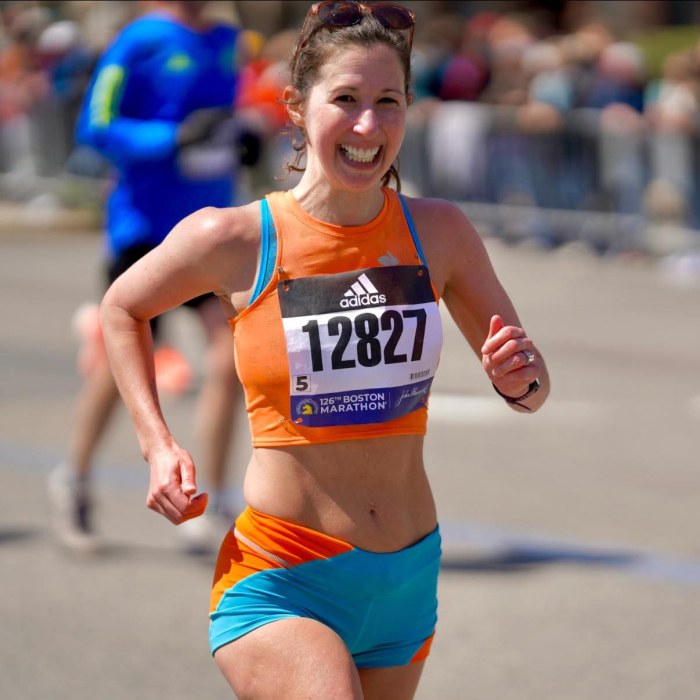

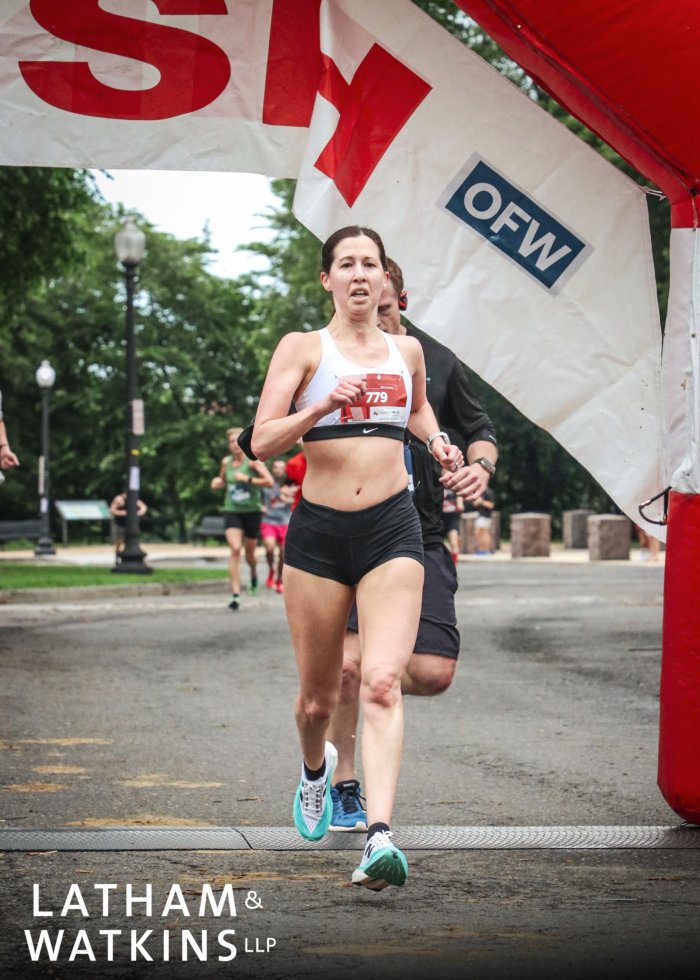
(Photo by MarathonFoto)
Categories: Athlete Profiles
 Runner's Gazette
Leave a comment