
An interview with Keira D’Amato by George Banker
In the age of technology an Internet search for injury recovery offers the following, “In the context of Artificial Intelligence (AI), “recovering from an injury” means using data analysis and machine learning algorithms to monitor a patient’s progress after an injury, allowing for personalized treatment plans, real-time feedback on rehabilitation exercises, and prediction of potential setbacks, ultimately aiming to optimize the recovery process and achieve the best possible outcome based on individual needs and progress data.”
No matter the level of performance, an athlete does not welcome being sidelined because of an injury. There is no ideal time for an injury. An injury stirs the emotions and creates mental stress. A physical injury can cause a mental injury, and this will lead to a dual recovery process. There is no universal book that will provide a recovery program.
An injury can setback the novice to the elite athletes. The process for recovery can vary individually. Not everyone has access to the technology available, noted above.
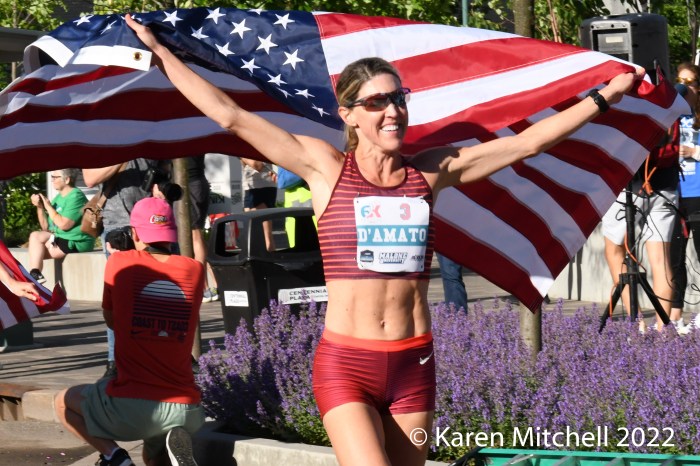
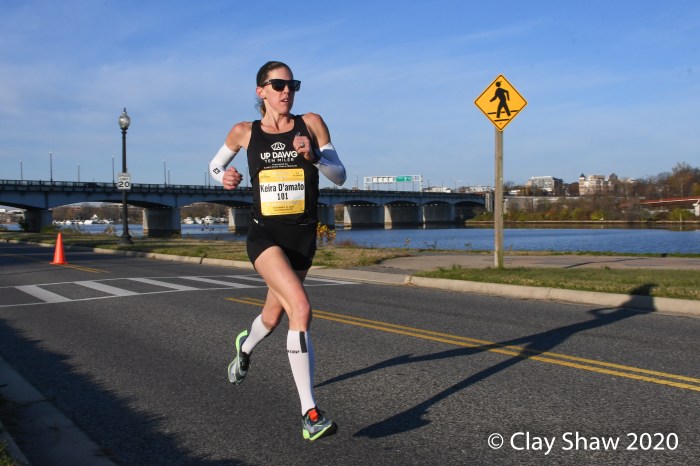
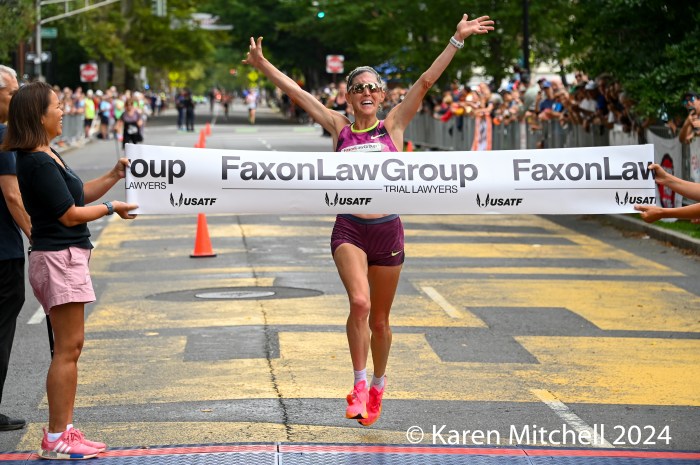
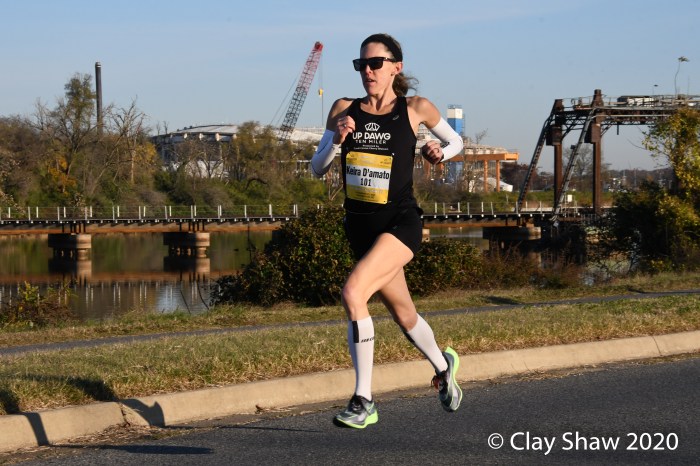
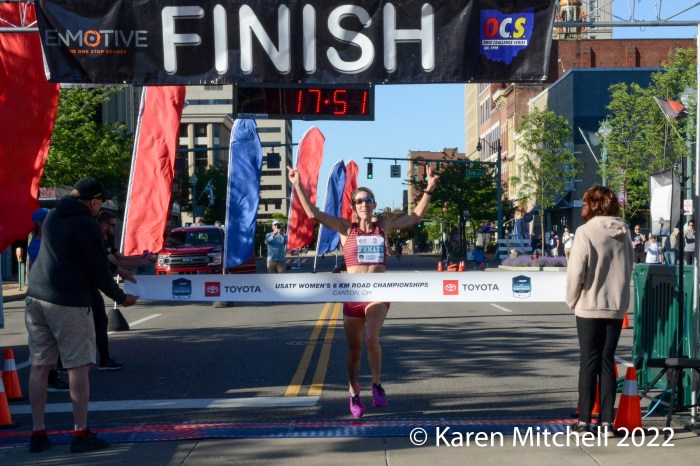
Keira D’Amato of Virginia is a distance runner and has set record-breaking performances. Prior records included the American record for the half marathon (1:06:39, Australia 2023) and the American record for the marathon (2:19:12, Houston, TX 2022). D’Amato is a four-time USA Track & Field national champion.
While attending American University (2002-2006) she was a four-time All American and 11-time Patriot League champion.
There have been many performances over the years, with more to come. There have been days when the level of performance was not at 100%. The setbacks came as injuries which have you asking, “Do I want to continue?”
D’Amato has answered the question with a yes, many times over. She will share her thoughts related to injuries and recovery. “Running is a gift; I feel truly lucky to have the time/energy/health/support to do it because it brings me a lot of joy.”
Can you recall your first injury which caused a break in your competition and how did you process the recovery process?
The first big injury I had that caused a break in my process was in high school. Going into my sophomore year, I developed a knee issue that prevented me from competing at States. I was heartbroken, embarrassed, and so frustrated. But it caused me to look inwards and ask ‘how I got here.’ For me, it was a combination of growing (out of my control) and lack of summer training (in my control). From then forward, I decided I wasn’t going to cut corners and show up unprepared.
Injuries, setbacks, sicknesses are all terrible. No one likes them and it’s hard to process being forced to take a break in the progress. The silver lining of them is your body is telling you there is a weakness and if you can find the cause of it, you come out on the other side better, stronger, and hungrier . . . and not to mention, feeling like you’ve been given this beautiful gift of another chance.
After the recovery, did you return to your prior performance level, or was there a gradual return?
There is always a gradual return, which, for my impatient peeps, feels like you are taking a step back. Here’s the good part:
- You are stronger. From the injury, you learned more about your body and how to prevent ending up back there. This is powerful. You are now a smarter athlete.
- You may start a few steps back, but you will see noticeable progress every week. Give yourself some grace to start right where you are and track the progress. Do your best not to compare to where you were before the injury. Instead, focus on where you are going . . . and you are going UP!
- You are hungry. Not being able to run may feel like a punishment, but when you come back, it feels like a gift. Lean into being grateful and excited to be back at it: a fresh perspective shift goes a long way!
Is it possible to have a physical injury that causes a mental injury in that you doubt your ability to be to return to competition?
Always. Every injury I’ve had, I’ve let the dark thoughts come in and wonder, is this forever? Will this ever end? Are my best days behind me? The answer is no, the best is yet to come. When you return, you will find goals that excite you and allow you to find your new best.
My mantra during injury, ‘this too will pass.’ Before you know it, the injury will be a speed bump in your rearview mirror.
There are articles which address running injury free. Do you think it is possible to run injury free?
Absolutely! If that’s your goal. This approach is conservative, involves listening to your body, and not overdoing it. A large part of this plan is making sure you are recovered and not pushing the limits. And that is a GREAT goal!
For others, we are training to find limits: running our fastest, our farthest, new challenges, see what we are capable of . . . trying to find the limits is sometimes hard to not redline it . . . I always tell people I’m training on a razor’s edge of finding my best ever or possibility overdoing it. You hope you don’t overdo it, but it’s a risk when you are finding new limits. We all understand this is a risk, but we do it anyway. Living on the edge can be fun too.
Have you reached a point where you doubted your ability to return to competition after an injury?
Early in my career, yes. But two of my most serious injuries that took me out of running for 3+ months were followed by my American Records in the Marathon and Half Marathon. That’s been great for confidence, because it’s a good reminder to focus on the small things, fix your weakness, and you can continue to make progress in different ways.
Your body will recover just fine after an injury. It’s the mentality that takes more work.
How important is a coach in the training process?
A coach is really important because they see the big picture. Someone to hold you accountable, focus on the long game and long-term goals while us athletes are in the day to day of it, and someone to stay rational and calm when things aren’t going as we want them. Also, a coach with have experience along the path you want to go is a huge benefit too!
At an age when most athletes consider retirement, Keira D’Amato is just getting started. She’s determined to share the secrets of her success to help readers chase their own happiness, to dream a big, scary dream, and ultimately to find their way back to themselves.
Keira’s book is due out in September, “Don’t Call It a Comeback: What Happened When I Stopped Chasing PRs and Started Chasing Happiness” It’s available for sale on 9/9/25 and can be pre-ordered now. (Runner’s Gazette staff can’t wait to read it!!)
Banker: No matter your sport or level of performance, it all comes down to your mental state. When was the last time you approached a starting line and stated, “I don’t care about my time, I just want to finish.” Your make up is to test your abilities.
D’Amato has additional comments to share.
What advice can you share with other females with aspirations to become better?
To start, the only person who needs to believe in you is yourself. Yeah, it’s nice to have a fan club and a support crew, but you have to see it first . . . the others can be convinced.
Push away the mom guilt. It is OK to do something for yourself. I personally feel like it is a service to my kids to SHOW them things like setting goals, working hard, dealing with disappointment, prioritizing physical fitness/health, you name it. But you need to be flexible . . . and you may find yourself running at crazy times of the day or on a treadmill. Do what you need to do to make it fit. But make it fit.
Last, patience. Running is a slow, constant build and you need to be healthy to keep at it. Build slowly. You do not climb Everest in a day, but every step gets you closer to the top.
What are some thoughts you can share with other females who wish to pursue a competitive sports career?
Go for it! You never know what journey you will start by accepting the challenge. It’s always worth it to go for your goals and dreams. Women’s sport needs more athletes. We need more diversity in the story, and we need more unique perspectives to elevate our sport to the next level. The more women that commit to going for it, the higher level we will all reach. The courage to start is within you – you’ve got this!
What is your WHY for chasing your dreams?
My WHY is always evolving as I grow and learn, but the deepest WHY is because it makes me happy. It is as simple as that. Making goals and going for them all out makes me happy.
I also run to see how fast I can become, but running is not always about that for me.
Do you have any thoughts about changes you would like to see in the sport for women?
I would like to see an opportunity for more girls and women to participate. There are several reasons women drop out of sport: changing body, lack of proper gear, self-consciousness, lack of opportunity, becoming mothers, etc. I am hoping we can continue to tackle these hurdles and keep more women in sport playing longer.
I think having more women in coaching/mentoring positions will help these goals, too.
I get asked all the time how long will my body last? I intend to push this limit to it is fullest to show how long we can all pursue sport.
What part does family play as you are training? My family plays a huge part – they are my world. They provide me support, love, discipline, perspective, and the ability to go big without fear of failing. No matter if I win or fall short, I come home, and they ask me what is for dinner. That gives me the freedom to really go for it and not worry about the outcome. That is a powerful thing.
Categories: Athlete Profiles
 Runner's Gazette
Leave a comment