
Interview with David Sinclair by George Banker
It is difficult to explain the terrain a runner must face while in competition at the JFK 50 Mile. The average runner who steps off the paved roadway leading to the Appalachian Trail may stop and say, “NO WAY.” One look at the rocks, call it a day and run a 5K instead. The rocks can scare the bejesus out of you.
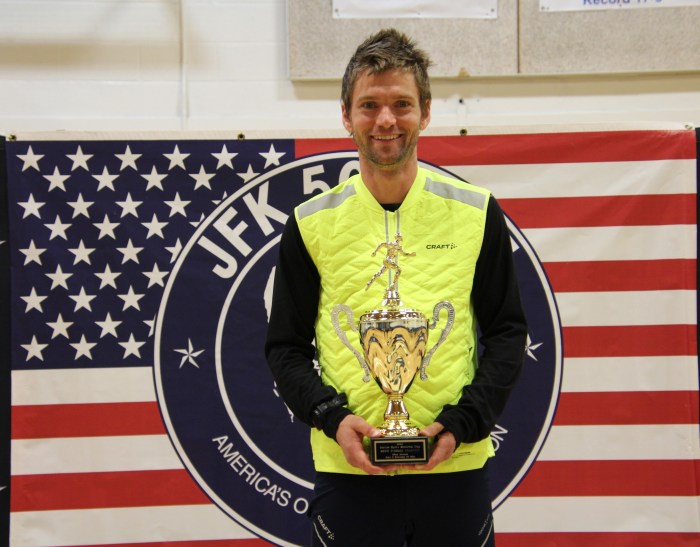
If you are David Sinclair, you start to smile and say, “Bring it on.” David’s recent record setting time (5:08:27) smashed Hayden Hawks’ time of 5:18:40 (2020). The previous record holders only improved the times by a couple of minutes. This time was insane. It makes you pause to consider how long this time will stand.
Lace up your shoes and get comfortable, because it is time to read about running 50-miles. A word of caution: do not try this at home; Sinclair is a professional. This is the race your mother warned you about.
What was your motivation for running the JFK?
My major motivation was the history of this incredible event. This motivation grew even stronger after I ran the race, seeing all the historical sites along the route and experiencing the passion of the local running community and volunteers for this event.
So many top USA ultra-runners have proven themselves at JFK over the years, and it is fun to be a part of its 62-year history. I was drawn to beat the times of great ultra-runners like Max King, Zach Miller, Jim Walmsley, Adam Peterman, and many more.
I was also attracted to the challenge of such a unique event with the first 15 miles on the technical Appalachian Trail and then all the flat and fast running afterwards. It is completely unlike any ultra I’ve done before, but I also thought it would be in my wheelhouse, with my success in technical mountain races and my past success with road marathons.
What was your strategy going into the race?
My main strategy was to be conservative while keeping myself in contention for the win, rather than aggressively chasing a time goal. However, I knew Eli would be incredibly strong and made sure not to let him get a substantial lead.
The focus in training was doing enough trail running to be comfortable on the AT while developing the running economy around a 6-min pace.
In the race, I focused on running as relaxed as possible to conserve energy, as well as keeping up with fueling to avoid a “bonk” in the later miles. I also pushed the technical downhills a bit on the AT to put my competition under pressure, but without going so hard as to tire my legs or risk a fall. Once on the towpath, the focus was drafting as much as possible if I was around the competition, as the forecast was for a headwind and I find I run better following than leading.
What did you think about the level of competition?
I knew the competition would be insanely high this year but tried to focus on myself and my preparation to run my best race, rather than worrying about specific competitors. I didn’t look at the starter list until the night before the race, but had heard through the grapevine that Eli Hemming was running and I was nervous that Eli would be too strong to compete with after his results earlier this year.
At what point did you take the lead?
The first half of the race went according to plan except that I was running a few minutes faster than I expected in order to stay with Eli on the towpath. But I felt great running behind him, averaging near a 5:40/mile pace. It felt a bit too fast those first few miles and my calves and hamstrings were tight, but eventually I got into a flow state and the same pace actually felt easier.
The plan was to wait and make a move up the big hill when we got off the towpath, but Eli slowed slightly around mile 36, so I made my move earlier than planned at about mile 38, after we’d slowed to over 6-minute pace for the first time on the towpath. I made a strong acceleration to make sure I’d drop him and then settled right back into a comfortably hard pace, knowing I had many difficult miles to go, and it would feel more tough running alone.
Were you concerned that Eli would attempt to reel you in?
I waited to make my move only once I was sure Eli was slowing and must be hurting more than I was. I got a gap easily enough that I knew major cramping was the only way Eli would catch me. Once I made the move (around mile 37), I pushed a bit more so that Ryan and Matt would have a hard time catching me, as I knew they were only a few minutes back.
What is your WHY for staying in the sport?
I stay in the sport because of my passion for the trails and the people and places I get to go and meet in this sport. Trail and ultra-running have taken me to so many incredible places and I’ve met so many wonderful and passionate people. I also just enjoy the process of training and trying to reach my potential.
What was the most challenging part of the course for you?
One of the most magical parts of ultra-running is that the more prepared and fit you are, the easier the races become. I had many tough days of training in preparation, but most of the race honestly didn’t feel difficult with all the adrenaline and excitement.
I’m actually more in awe of the runners that push through incredible fatigue to finish close to the 13-hour cutoff. I have the privilege right now to train full-time while mid-packers are fitting their training into much busier and more stressful lives, and they are just as impressive as the fastest athletes.
The towpath section was probably the most difficult portion of the race for me because it is such a long stretch with the least variety. You are already tired from the AT but still have so far to go that it is really difficult mentally from a pacing and effort management standpoint.
Did you learn anything about yourself?
I often have a hard time believing that I am talented enough and working hard enough to be among the best ultra-runners in the country and world. After being able to push so hard and run so strong on Saturday, I am believing I’m putting in the work and truly can be one of the best in the world at this sport.
Categories: Athlete Profiles
 Runner's Gazette
Leave a comment