
by George Banker
(Photos Courtesy of Chicago Event Management)
According to Wikipedia, the term “Stewardship” is an ethical value that embodies the responsible planning and management of resources. The concepts of stewardship can apply to the environment, nature, economics, health, places, and property.
I will submit that over time, the nature of running events has progressed to complex business ventures. The backdrop continues to be health and fitness. Upon closer inspection, the management comprises stewards. There are various names assigned to those in position, but the responsibilities are important.
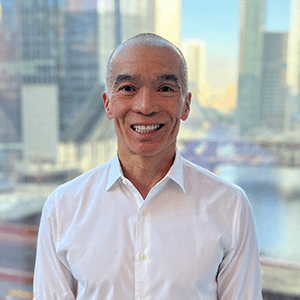
The Chief Operating Officer for the Chicago Event Management, Michael Nishi, joined the organization in 1990 with Carey Pinkowski as General Manager and the Executive Race Director of the Bank of America Chicago Marathon.
Last year the Chicago Marathon had 48,574 finishers. Since the race’s inception, there has been a growth in the participants, volunteer requirements, and the overall race organization.
As you read through the below responses, keep the following three words in mind: consistent, insistent, and persistent, the words you can associate with Nishi. You may not know him, but you will know that he represents the knowledge and the experience that he has communicated throughout the organization.
What was your progression into sports event management?
My first experience with the Chicago Marathon was when I ran it my very first time at 13. I was not prepared or trained properly and jumped in head first, not knowing how that would begin this incredible journey that I’ve been on. Fast forward to the early ‘80’s and I had the great opportunity to be an intern for Flair Communication, a promotional advertising agency that founded the Marathon. After working over summers and events, I started working full time with the Marathon team in 1990 and after that, it was history.
From the onset, did you have an athletic background?
I did not have an accomplished athletic background, other than participating in Track & Field and Cross Country during middle and high school. After that, I started running races and really enjoyed the joy of running and training, and mostly, not for any particular races. Of course I trained for some races but really appreciated what the sport offered for challenges, health & fitness, and the social aspect it offers when being part of groups and teams.
How has Chicago Event Management grown over the years?
When Carey Pinkowski and I started working on the marathon together in the early 1990’s, we might have had 5,000 runners taking part. After many years of slow growth, strategies that paid off, and with luck, we will plan for 50,000 finishers this fall. We worked on the marathon through four different companies and would form Chicago Event Management (CEM) on March 20, 1996–being at the right place at the right time (that’s where luck played a huge role of who we are today). We started small, like every beginning event company, maybe six of us getting started, to now having a team of over 40+ full-time staff members.
Can you provide a list of the top three challenges you encountered and how you resolved them?
There were so many challenges over the decades. I’d have to say in the ‘90’s it was financial, needing to attract more runners, sponsors, and reduce expenses over those years. As the event started to grow and see success, then it was more operational during the 2000’s. It was a beneficial situation to be in: to have more revenue to build the event, and adding more resources and amenities necessary to manage a larger field over those growth years.
During the 2010’s our races were experiencing substantial growth so obviously we would stay focused on enhancing our company’s and event’s financial growth and stability, operational excellence and continued improvement, and then there was truly a shift after major tragedies that struck our country and globally, and we needed to focus so much more of our energy, attention and resources on Safety & Security, as well as the administrative side of our business and events when it came to legal, insurance and finance.
As we are almost midway through the 2020s, we find us continuing to focus on everything that it’s taken to get here and we’ve really been focused on the purpose and effect our company and events have on our communities, city, state, country and globally. In 2020, during COVID we had time for self-reflection as individuals, as a group and company, and we took that time to look internally and better identify and express who we are as an organization; our Vision, Mission, and Purpose. We’ve been working hard with our team members to operationalize our VMP’s in our company, through their work and in our events, especially when it comes to Social and Environmental Responsibility.
How important is safety and security to an event?
Safety & Security is critical to our company and events. It is one of our pillars that we build into all of our events; i.e., Safety, Leadership, Experience, Social & Environmental Responsibility.
If you had to evaluate an event, what would you look for?
Based on how we’ve grown as an organization over all those years/decades, I would assess an event based on all the above; Organizational & Financial: financial, insurance, and legal; Operations & Logistics: Staff organization, operational plans, contingency planning; Leadership & Management: workforce management, roles & responsibilities, and training; Experience: how engagement is created for all stakeholders (participants, volunteers, fans, sponsors/vendors, etc.) from entry to exit. No longer can we just focus from just the start to finish; experiences begin when we connect with the person and after they’ve taken part. Finally, Social & Environmental: what initiatives are companies and events taking to address these areas of opportunities
What changes have you seen in the sport?
Our sport has definitely been more inclusive when it comes to sharing leading practices, which has enabled us to improve and evolve our sport and industry. We have a lot more to go, especially when it comes to Social & Environmental initiatives, and I feel an advantage we have is a close-connected industry; we will affect change faster than many other industries by how we share our plans and practices.
What are some changes/improvements that you would like to see in the sport?
We need to be more inclusive and accessible to more people from a participant and workforce standpoint. Most our companies and events are not a reflection of our communities and we need to provide more access and opportunities that our great sport and events offer–the current leaders and participants know the benefits that our sport, activity and running can do for us, the impact that has on our families and communities, and imagine when we can get even more people involved, especially from our marginalized and under resourced communities.
Have you had any personal changes because of being involved in the sport?
Absolutely, I have grown personally and professionally. All my personal and professional growth has been because of the sport and has helped me become the person I am today. I have everything that I’ve been afforded in my life because of this sport and profession.
If you had to choose between quality of an event versus quantity as it relates to size which, would it be?
Quality would be my choice every time. When you have quality, you will be able to grow, and quantity is an outcome of quality.
What is the value of volunteers for an event?
Volunteers are the critical ingredient of our events. Without them, we could not create or operate the events of our size. They also add to the experience that our participants and fans expect; volunteers are part of our communities and help us share who we are as a city when they are folded into our mix. It’s also critical that we recruit more volunteers from various communities to provide access and opportunity, as well as begin to develop and inspire our next generation of participants, professionals, community and industry leaders.
When it comes to event management relative to the sport, what are the qualities/skills that a person would require?
There are obviously some specific technical needs based on certain roles. However, the fundamental qualities that I look for in team members for our company are: Innovation: the ability to come up with ideas and solutions; Discernment: ability to think critically and question how or why we do things; Enablement: willingness to help others no matter the role; Tenacity: attention to details and following through on what’s necessary.
What is your philosophy when it comes to event management?
I’m going to share CEM’s Mission, which reflects what’s important to the founders: “Our Mission is to create the challenges that bind us together and, through shared struggle & experience, emerge our best selves in the service of each other.”
I believe that statement sums up why we do what we do and how we do it and for whom.
What would you want the reader to know about Michael Nishi?
While the previous information provides an excellent overview, I want to highlight my passion for building communities and addressing issues around shared goals. For instance, we created the Race Management Program over 15 years ago to share leading practices and innovations with our industry, in order for us all to continue to develop and grow more efficiently by bringing people together to share ideas and experiences.
Another example of how we’re addressing issues in our sport and globally: we have been a leader of sustainability, achieving Council for Responsible Sports’ highest Evergreen Level over a decade ago and continuing to inspire our participants, volunteers and fans to be part of this journey together.
Ultimately, I’m driven by the opportunity to share my passion and expertise with others, contribute to the CEM’s and our event’s success, and continuously learn and grow in this dynamic industry.
Categories: Features
 Runner's Gazette
Leave a comment