
By George Banker
The JFK 50 Mile (JFK) is the oldest continuously held ultramarathon in the US. On November 18, 2023, the race celebrated its 61st run. Throughout the years, thousands have started the race in downtown Boonsboro, Maryland, and hundreds have not completed the race. What matters is not the size of the race, but the size of the heart of each participant. The JFK is the race your mother warns you to do your research before you sign up. To the elite it is a race, and to the rest of the participants it is an endurance challenge.
The event is an ultramarathoner’s dream with no vehicular traffic and a return to nature. Try to visualize the following as you read the course description. The first 5.5 miles (starting on the road surface and joining the Appalachian Trail (AT) at 2.5 miles) gains 1,172 feet in elevation. The course from 2.5 to 15.5 miles is on the AT (except for two miles of paved road between 3.5 and 5.5 miles). This section of the AT is very rocky in sections as it rolls across the mountain ridge. At approximately 14.5 miles, the course drops over 1,000 feet in a series of steep “switchbacks,” then crosses under Rt. 340 and connects with the C&O Canal towpath. The “Canal” section of the JFK 50 Mile is 26.3 miles (from 15.5-41.8 miles) of almost totally flat unpaved dirt/gravel surface that is free of all automotive vehicle traffic. The JFK 50 Mile route leaves the C&O Canal towpath at Dam #4 and follows gently rolling paved country roads the last 8.4 miles to the finish. The Boonsboro start is at an elevation of 570 feet. The Williamsport finish is 452 feet above sea level. How would you manage the above if there were snow along the AT?
It takes skill and determination to make it through one JFK. What does it take to run the JFK 36 times? The Queen of the JFK as I will refer to Carolyn Showalter of Maugansville, MD. People outside of the JFK Family may not know the name. Schowalter has achieved a status that will take years to match by another female. The chance of her record being broken may never take place. Many people believe records are meant to be broken. The three words which define Schowalter are consistent, insistent, and persistent as it relates to her training. Schowalter’s record at the AT will be difficult to surpass as she continues to dominate. Is it magic? Schowalter has the answer.
Before we start on the journey, here are a few key dates of her prior performances:
1st JFK Finish 1978 11:39:20 6th female
10 JFK Finishes 1988 7:57:16
20 JFK Finishes 1998 8:59:02
30 JFK Finishes 2017 11:31:06
35 JFK Finishes 2022 12:12:37
36 JFK Finishes 2023 12:40:48
Schowalter shares the story of how this incredible journey started. At the time, there was no thought about history making or longevity. The best outcomes result from following your heart and being true to a passion.
Think about your life and how much time you devote to training and what do you give up? Think about family, work, and friends. Where is the balance?
Schowalter stated, “I always enjoyed games and play that involved running from playing in the yard at home with my siblings, to recess at school, and physical education classes in middle and high school.
“In the late 60’s I started reading results in the newspaper about the JFK 50 Mile and was especially interested in seeing how Donna Aycoth did. [Note: Donna was the first woman to finish the event (1969–9:27:31) and also win for the next five years.]
“In 1974, my two younger brothers, Lowell and Linden, decided to run the JFK. Lowell is 3 years younger than me, and Linden is 5 years younger. That was the year it was 30 degrees and freezing rain all day. They got as far as mile 30 and were wet and cold to the bone and could not go farther. The following year, they both finished (Lowell 10:39:21 and 10:39:22). That was the beginning of Lowell’s 14-year streak of finishes.”
The outcome for Linden was not as successful as Lowell. Schowalter comments, “Linden trained a few more years but kept getting shin splints and could not run the race. I would ride along with my parents to meet Lowell at various places along the course, and the seed planted in the back of my mind about doing the event kept growing.”
Schowalter adds, “I had been on the girl’s track team for my junior & senior years of high school, but just ran shorter events (220 yds, 440 yds, and 440 relay). After graduating in 1972, I still did some running on my own, but only a few miles at a time. So, I decided to try running the JFK 50 in 1978. I do not remember much about my training, except that my longest training run was 10 miles. The goal was just to finish, which I did in 11:39:20.”
There were some years where things did not go as planned. “In 1981, I started having stomach issues in the second half of the race and at mile 42, felt like I could not go any farther and dropped out. About a week later, I had second thoughts and wished that I had just tried walking the rest of the way, because I would have had plenty of time to do that. There were a few other years that I had stomach issues, but remembering what happened in 1981 helped me to keep going and finish in those years.”
Schowalter stepped up the training to get to the next level through a series of events. “After that first JFK 50 finished, I knew I could do a marathon, so I ran one marathon per year as part of my JFK training. I ran the Gettysburg Marathon four years and improved my time by 15 minutes each year and started thinking of qualifying for the Boston Marathon. In ’83 they no longer held the Gettysburg Marathon, so I ran one in Waynesboro, VA and qualified for Boston with a time of 3:01:34. I ran the Boston Marathon in 1984 with a PR time of 3:01:14. I eventually ran marathons in Chambersburg, PA, New York City, Carlisle, PA, Virginia Beach, and Boston again in 1988 (3:04:50). There were six times that I finished in under 3:05 but could never break the three-hour time barrier. I also ran many 10K and 5K races and a few half marathons in the local area, which helped to improve my time in the JFK 50.
“The 1984 JFK was a breakthrough year because it was the first time that I finished under eight hours and was the third woman (7:56:27). It gave me hopes of winning the event sometime. In 1983 and 1984, Teri Gerber had won the event with sub-7-hour course record times, but she did not come back in 1985, so that was the first year that I was the women’s winner (7:59:24)! I won the next four years as well. During that time, I trained six days a week, often running 10 miles a day, and started doing long runs in August leading up to the JFK. From 1984 to 1989, the total number of miles I ran each year was between 3,000 and 3,200 miles. In the 1990s, the women’s field was becoming larger and more competitive,” stated Schowalter.
Schowalter continues, “My three quickest finishes were in 1990 (7:44:13), 1991 7:38:00). and 1992 (7:46:04), maybe because I was chasing after the women ahead of me. My PR of 7:38:00 was in 1991 and I finished less than two minutes behind the runner-up. I got another win in 1994 (7:58:15) as a 40-year-old, with a sub-eight-hour time. After 1996 (8:02:56), I think my age was catching up to me, with significant increases in my finish times.”
The 2003 was special as Showalter adds, “Lowell, Linden and I were all running for the first time. We had not trained together and did not know how close we would be to each other. But at the end of the towpath, we were still together and decided to stay together and cross the finish line as a tie (9:51:07).”
“In 2003, that was also the last time that both of our parents were there to see us finish. In 2004, my mom passed away from pancreatic cancer and in 2006 my dad passed away from prostate cancer. After that 2003 race, I did not recover like I usually did, and my right knee kept having pain when I would try to run. Eventually, I had arthroscopic surgery in May 2004. My surgeon strongly recommended that I stop running, and at that point I thought that my running career was ended. Over the next few years, I did not run, but got more involved with cycling, just not on a competitive basis. I just enjoyed getting out and riding with friends, and did some week-long touring events,” Showalter added.
Schowalter adds, “At the 50-year anniversary of the JFK 50 (November 17, 2012) I decided to try training just enough to be able to get through the event and beat the cut-off times. I finished with a time of 11:44.56 and my knee did not bother me at all. So that is how I have been training ever since. My total miles that I run is just a fraction of what it used to be, from 300 to 350 miles per year. With an increase in mileage, there would also be an increase in risk of injury.”
The goals change over the years, Schowalter continues, “I probably would advise no one to train like I do now but found that it works for me. Now my overall goal is just to finish, but I do like to see how well I can place in my age group (60–69). I just feel very blessed and thankful to God for the ability to run the way that I have, and that I could come back to it after I thought my running days were over. I could not have done it without my parents meeting me at various checkpoints in the early years, and some friends who still support me, and also the many volunteers who help with many things to keep the race. I do not know how many more times I will be able to run the JFK, but I will take it one year at a time.”
There was in interruption in training plans as Schowalter comments, “In August 2013 I was doing a week-long cycling event and riding down a steep hill at 30+ mph. I did not see a groove in the road that my front wheel dropped into and caused me to do a face plant on the pavement. I had a twisted ankle, among other injuries, but I am very thankful that it was not much worse. In October, when I tried to do a long run, my ankle still bothered me too much, so I withdrew my entry for that year’s JFK.”
Schowalter shares the following for beginners: “To a person who is doing the JFK for the first time I would say–Look at it as three races in one. Be patient on the AT and walk up the hills and try to get off of it without injury. Then use a run/walk strategy on the C&O towpath and do not spend too much time at the aid stations. For the last 8 miles, walk up the hills again and try to run on the flat areas and downhill. Then enjoy. the accomplishment of crossing the finish line!”
She adds, “Some changes I have seen over the years: When I first started running it, we had to have our own support to provide food and drinks, so the well-stocked aid stations are an enormous improvement. There are improvements in running shoes and other gear. Before the mid-1990’s about 10% or less of the finishers were women, and this past year that percentage was 24%. Also, I am just amazed at how much the JFK course record time has decreased for the women (and also the men).”
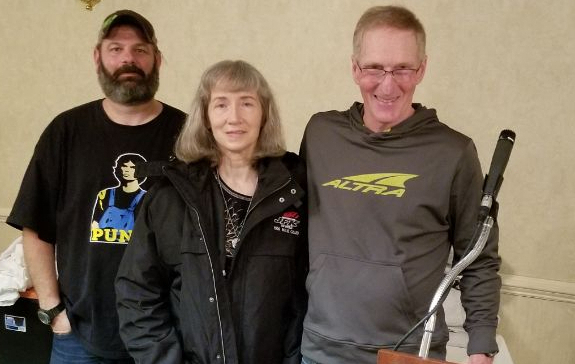
At the 61st running of the JFK (November 18, 2023) the Showalter clan was out in force. Leading the way across the finish line were Linden (Waynesboro, PA) and son Grantley (Alamosa, CO) at a time of 9:35:36. Crossing in a time of 12:40:48 was Carolyn and brother Lowell (Clarkston, MI). This may be another record to add to the history books.
As Showalter “Queen of the JFK” stated, she will take it one day at a time as she remains consistent, insistent, and persistent. Watch the starting line in 2024 as Showalter will seek to claim number 37.
Categories: Athlete Profiles, Features
 Runner's Gazette
Leave a comment